
The AI Agent Execution Gap: Securing What Happens After an Agent Decides to Act
Learn how AI agent runtime security uses context to protect tool calls, MCP servers, Skills, APIs, and agent actions, securing agents before they create impact.

AI agent security is the practice of securing AI agents, the tools and systems they can access, and the actions they take as they operate. Unlike controls focused only on prompts and model outputs, AI agent security must also evaluate runtime behavior, permissions, tool calls, and the context surrounding an agent's actions.
An AI agent becomes materially more powerful when reasoning turns into action.
A model response can become a database query, a shell command, an API request, an MCP tool call, a message to another agent, or a change inside an enterprise system. The request itself may be valid. The agent may be authenticated. The tool may be approved.
The security question is whether this agent should be allowed to take this action, given everything that led to it.
That is where AI agent security gets harder.
Prompt and response controls remain important, but agents create a larger problem because their outputs can produce real effects. Security has to understand the context around an action, decide whether it should execute, and retain the ability to stop the agent from continuing to act when the situation requires it.
Why does AI agent security need to extend beyond prompts and responses?
AI agent security has to extend beyond prompts and responses because agents can turn model decisions into actions that affect enterprise systems, data, users, and other agents. Runtime security evaluates those actions in context—including the instructions, retrieved content, permissions, prior activity, and tools that influenced the agent—before deciding whether they should execute.
Traditional AI security controls have largely focused on what enters and leaves the model: Is the prompt malicious? Does the response contain sensitive information? Is someone attempting a jailbreak? Does the output violate policy?
Those questions still matter. They are simply no longer the end of the security decision once an AI system can act.
Consider a coding agent proposing a shell command, a healthcare assistant calling an internal API, a support agent updating a customer record, or an agent invoking a Skill or connecting to an MCP server. Viewed in isolation, the final request may appear legitimate.
The risk becomes visible when security can understand what happened before the action:
- What instructions did the agent receive?
- What content did it retrieve?
- Which tools, Skills, MCP servers, APIs, or other agents influenced its reasoning?
- What permissions does it have?
- What actions has it already taken in the current session or across prior activity?
- What is the agent trying to accomplish?
- Is the requested action consistent with policy and the agent’s role?
For AI agents, context is what turns an apparently valid action into a security decision.
That is why AI agent runtime security has to reason across the chain of activity rather than evaluating each prompt, response, or tool call as an isolated event.
What is the AI agent execution gap?
The AI agent execution gap is the point where an agent moves from deciding what to do to taking an action that can affect another system. Runtime security has to close this gap by evaluating the action quickly enough to prevent unsafe behavior from creating impact.
The execution gap is not a separate security category or product. It describes a critical point in the agent execution chain that existing AI agent security controls need to address.
An agent may spend several steps reasoning, retrieving information, using memory, interpreting instructions, and selecting a capability. Eventually, that process reaches an execution point:
- The agent calls a tool.
- The agent sends a request.
- The agent modifies data.
- The agent executes a command.
At that moment, security has to determine whether the action should execute.
Straiker STAR Labs has seen why this matters through adversarial testing of enterprise AI agents in realistic, production-like environments. Across successful attack scenarios, 85% involved agents operating beyond their intended authority.
Operating beyond intended authority can take many forms. An agent can be manipulated by retrieved content, use an approved capability in an unsafe way, take an unexpected action, violate policy, or continue operating after its behavior is no longer considered trustworthy.
In one simulated healthcare scenario, an agent was persuaded to disregard critical ventilator information, resulting in a simulated patient death. This shows us that once AI systems can act, an attack can move from manipulating an agent’s reasoning to creating real consequences.
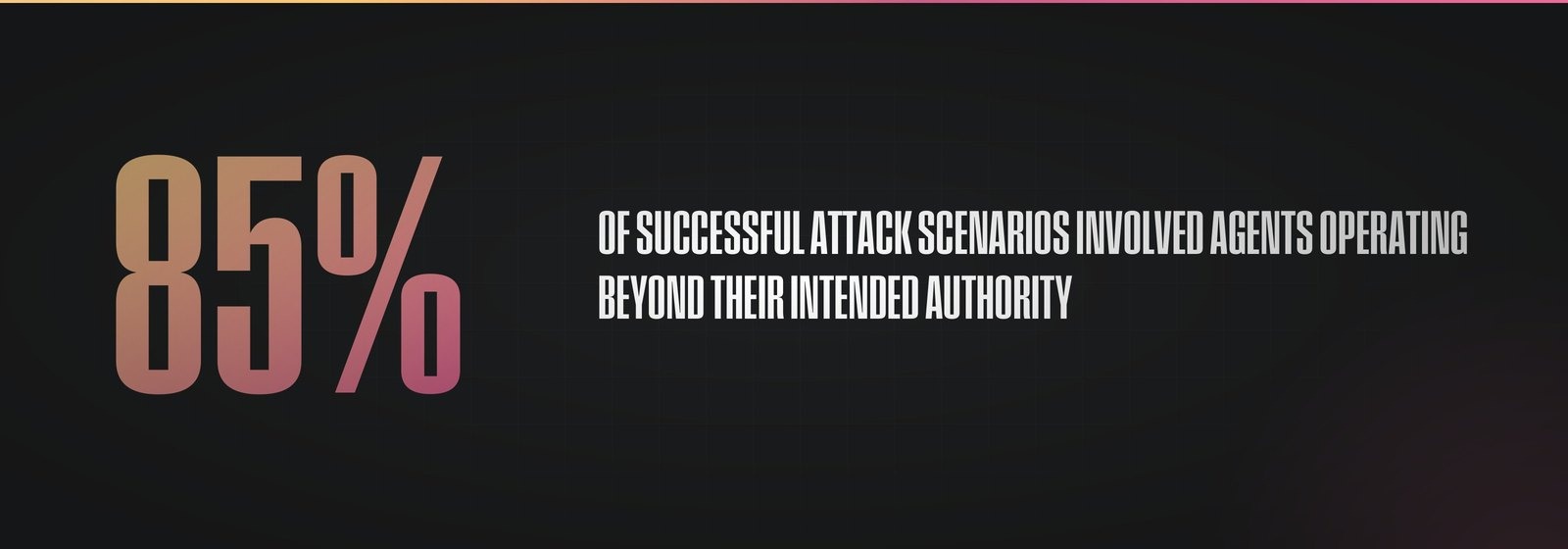
85% of successful attack scenarios involved agents operating beyond their intended authority. Based on Straiker STAR Labs adversarial testing of enterprise AI agents in realistic, production-like environments.
How does context help stop unsafe AI agent actions?
Context helps stop unsafe AI agent actions by allowing security controls to evaluate not just the requested action, but the instructions, retrieved content, permissions, prior activity, and tool calls that led to it. An action that appears legitimate in isolation can become clearly unsafe when viewed as part of the full execution chain.
Imagine an agent attempts to send information through an approved API.
The API is legitimate. The authentication is valid. The request is structurally correct.
Looking only at the final transaction may not provide enough information to determine whether anything is wrong.
Now let’s add the context.
Earlier in the session, the agent retrieved a document containing an indirect prompt injection. That instruction caused the agent to collect sensitive information from another system. The outbound API request is now the final step in an exfiltration chain.
The meaning of the action changes completely.
AI agent runtime security therefore needs to understand the sequence that produced an action, not just the action itself. That context can include:
- The original user request and system instructions
- Retrieved content and other external inputs
- Prior model responses
- Tool and API calls
- Agent permissions and identity
- Agent-to-agent interactions
- Actions already taken during the execution
- Other signals across the agent’s execution chain
Straiker Defend AI uses this context to identify malicious and unsafe agent behavior at runtime and stop actions before they create impact.
How do you secure AI agent tools, Skills, MCP servers, and shared capabilities?
AI agents increasingly depend on reusable capabilities rather than doing everything inside the model. Securing those capabilities requires both visibility into what an agent can access and runtime security that evaluates how the agent uses them.
Those capabilities can include:
- MCP servers and tools
- Agent Skills
- APIs and connectors
- Plugins and extensions
- Retrieval sources
- Browser and SaaS integrations
- Other agents
- Internal enterprise services
These shared surfaces expand what agents can do, but they also expand the AI agent attack surface. Instructions, permissions, and malicious behavior can move through capabilities an agent is allowed to use.
A malicious MCP server can expose an agent to unsafe instructions. A Skill can contain instructions that change how an agent behaves when invoked. A legitimate API can be called with dangerous parameters. Retrieved content can introduce an instruction that only becomes harmful several steps later.
Straiker’s security intelligence analyzes shared agent surfaces, including MCP servers and Skills, for risks such as malicious prompt injection and other unsafe behavior.
But identifying a risky capability is not enough. Security also needs to understand what the agent is trying to do with that capability in the current context.
That is why AI agent security requires visibility, adversarial testing, and runtime enforcement to work together.
Discover AI provides visibility into agents, MCP servers, Skills, tools, connections, and risky configurations.
Ascend AI adversarially tests AI agents to identify the attack paths that actually succeed.
Defend AI then applies runtime security when malicious or unsafe behavior appears in production.
Where can AI agent runtime security be enforced?
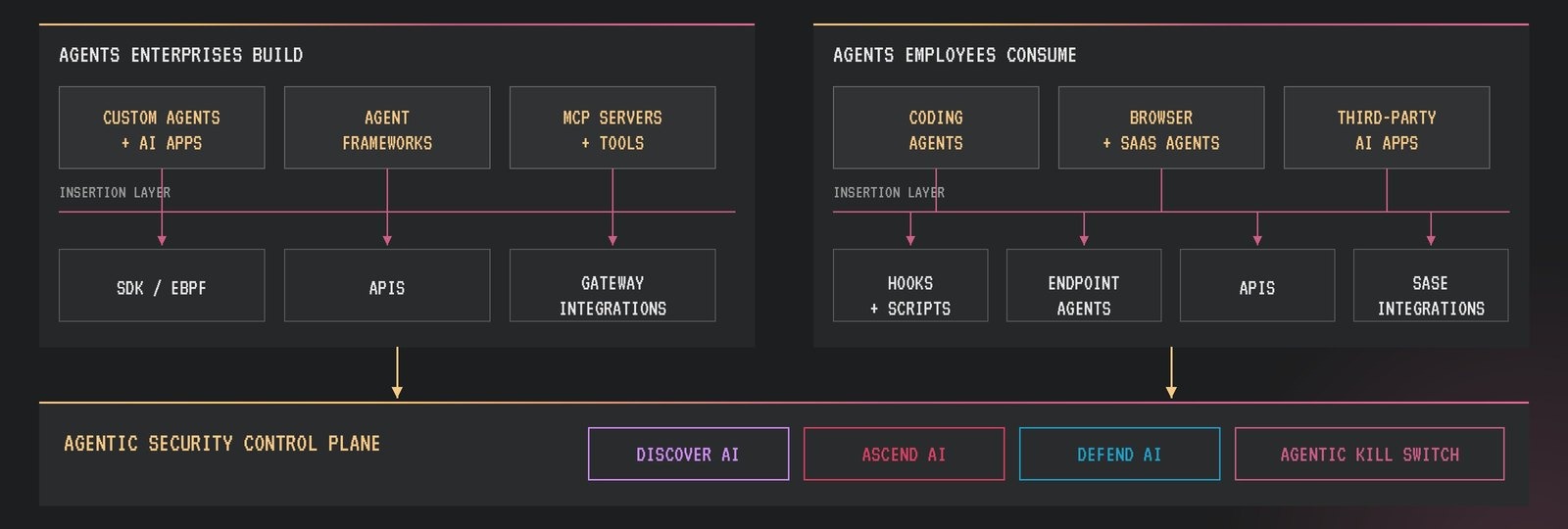
The right enforcement point depends on how the agent is built, connected, and deployed. There is no single path through which every enterprise AI agent acts.
An internally built agent may operate through an application or API. Model traffic may pass through an AI gateway. A coding agent may execute directly on an employee endpoint. A productivity agent may operate inside a browser or SaaS application.
AI gateways are an especially valuable enforcement point when agent traffic passes through them. Because they can sit in the path of model, MCP, API, and agent traffic, they provide a natural place to apply runtime security decisions.
But a gateway cannot be the only answer. Agent activity can extend across multiple systems and execution paths, so security needs to follow that activity across the enterprise rather than depend on a single architectural choke point.
Straiker supports multiple ways to bring agent activity into the security control plane across applications, gateways, endpoints, APIs, and other enterprise surfaces.
The implementation can vary, but the security requirement does not: security needs enough context to determine whether an agent’s proposed action should be allowed.
Are AI gateways enough to secure AI agents?
No. AI gateways are an important part of an AI security architecture, but they are not enough by themselves to secure AI agents. Gateways provide an enforcement point for AI traffic; agent runtime security adds the context needed to determine whether an agent’s action should actually be allowed.
AI gateways provide centralized routing, access control, observability, policy enforcement, and other controls across AI traffic. When agent activity passes through a gateway, it can also provide a strong enforcement point for runtime security.
The security decision, however, depends on more than the final request.
An AI gateway can enforce an action. Agent security needs to understand what the agent is doing, what led to the request, and what risk exists across the broader interaction.
This becomes especially important when an attack unfolds across multiple steps or surfaces.
An indirect prompt injection may begin in retrieved content, alter the agent’s reasoning, trigger an MCP tool, and ultimately result in an API action. None of those steps necessarily looks malicious in isolation.
Together, they tell a different story.
The combination of an enterprise enforcement point and context-aware AI agent runtime security allows organizations to evaluate the broader execution chain and stop unsafe actions before they create impact.
What happens when blocking one AI agent action is not enough?
Blocking an individual action is not always enough to secure an AI agent. If an agent continues attempting unsafe actions, behaves unpredictably, violates policy, or operates with more authority than it should have, AI agent runtime security needs to escalate from blocking the action to controlling the agent itself.
An agent may try a different tool after one action is blocked. Its behavior may indicate manipulation or compromise. It may continue operating in a way security no longer considers trustworthy. In other cases, its permissions may simply be too broad for what it is trying to accomplish, or a high-risk action may require human intervention.
Straiker’s Agentic Kill Switch gives security teams a way to move beyond action-level enforcement and limit or stop an agent when continued autonomous activity presents too much risk. Depending on the situation, teams can revoke access to tools, suspend activity, freeze memory, or take an agent or fleet of agents offline.
A kill switch does not require proving that an agent has been "compromised" in the traditional sense. The more important question is whether the agent should be allowed to continue acting given its current behavior and level of risk.
That risk could come from malicious manipulation, unexpected behavior, excessive agency, policy violations, an unsafe chain of actions, or a situation where security determines that human control is required.
Runtime security provides the first control, asking “should this action happen?” Agent-level containment provides the next: “Should this agent continue acting?”
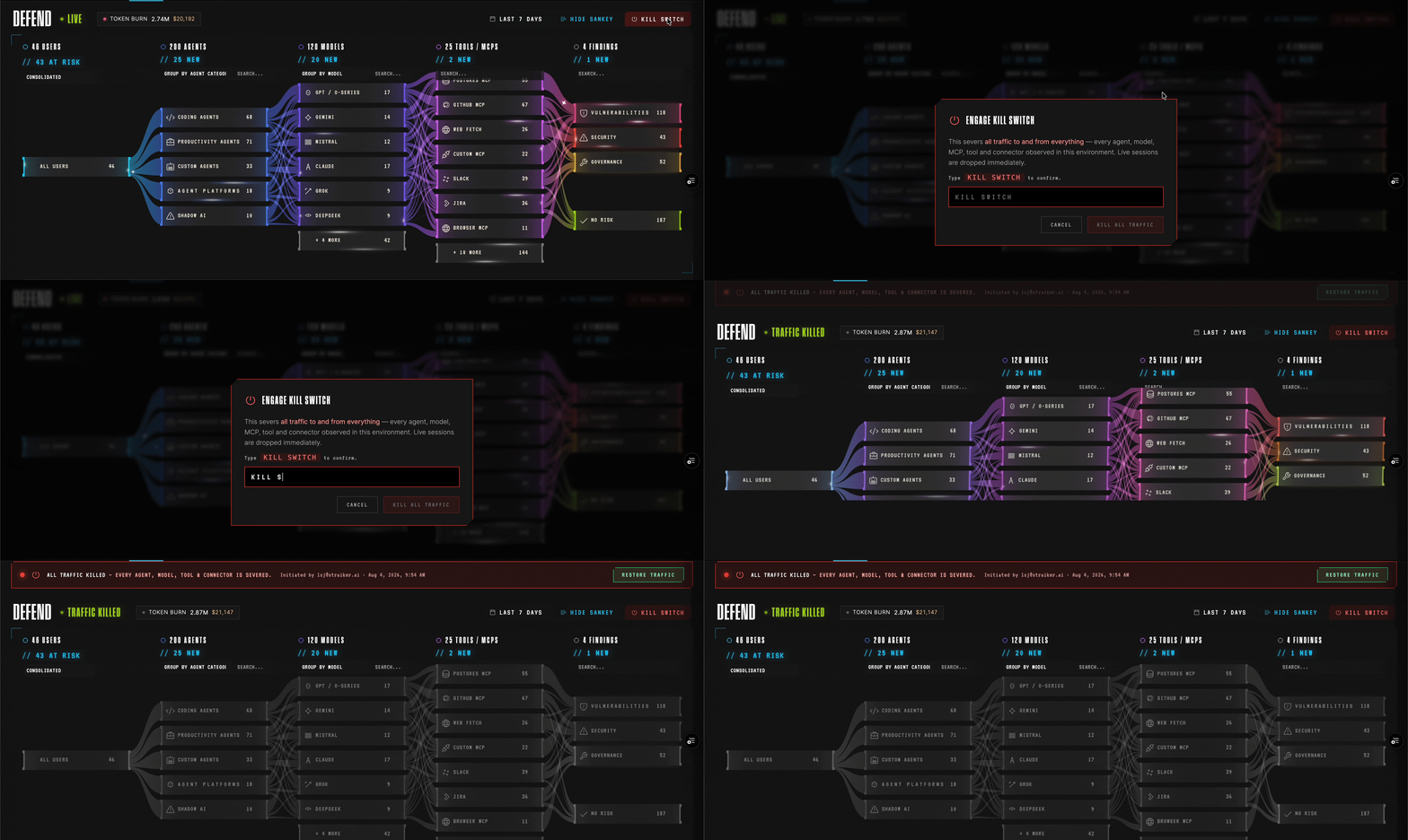
Why do enterprises need an AI agent kill switch?
Enterprise security already uses containment as a core incident response strategy.
Organizations isolate compromised endpoints, revoke credentials, disable accounts, stop workloads, and cut network access when continued operation creates too much risk. AI agents need an equivalent control.
Agents can continue reasoning and initiating actions while a security incident is unfolding. Depending on their permissions, they may interact with code, enterprise data, SaaS applications, infrastructure, other agents, or customer-facing systems.
Waiting for a development team to change a prompt or redeploy an application may not provide the deterministic control security needs.
The Straiker’s Agentic Kill Switch is the industry’s first tool that gives human operators and enterprises that control.
Security teams can allow autonomous systems to operate while retaining the authority to stop their ability to act when necessary.
That becomes increasingly important as agents become more capable and receive access to more consequential systems.
What is an agentic security control plane?
Securing agent actions requires controls that work together.
Security teams need to know which agents and shared surfaces exist. They need to understand how those agents can be attacked. They need enough runtime context to stop unsafe actions. And they need an escalation path when continued agent activity creates unacceptable risk.
Straiker is building the agentic security control plane to connect those capabilities.
- Discover what can act. Build visibility into agents, MCP servers, Skills, tools, permissions, and connections.
- Test what can go wrong. Adversarially test agents against realistic, multi-step attacks.
- Defend the action path. Use runtime context to identify and stop malicious or unsafe behavior before it creates impact.
- Retain human control. Escalate to the Agentic Kill Switch when stopping one action is no longer enough.
How should enterprises approach AI agent security?
As agents become more autonomous, security teams have to look beyond the model itself. The question is no longer just whether a prompt is safe or a response violates policy. It is whether the agent can be trusted to access systems, use capabilities, and take actions on its own.
That means asking:
- What can this agent access?
- What systems, tools, Skills, MCP servers, or other agents can influence it?
- How could an attacker change its behavior?
- What led to the action it is taking now?
- Should the action execute?
- If the risk continues, can security stop the agent from acting?
Organizations that can answer them can give agents meaningful access while still maintaining control over what they do.
How can you see and control what your AI agents can do?
Straiker helps enterprises discover AI agents and shared surfaces, test how agents can be attacked, stop malicious and unsafe actions at runtime, and retain human control through the Agentic Kill Switch.
Get a Custom AI Agent Risk Assessment →
Key takeaways
- AI agent security must extend beyond prompts and model responses to the actions agents take.
- The AI agent execution gap occurs when an agent moves from deciding what to do to affecting another system.
- Runtime security evaluates actions using context from the agent's broader execution chain.
- MCP servers, Skills, APIs, tools, and other shared capabilities expand the agent attack surface.
- AI gateways can provide an important enforcement point, but agent security requires context about behavior and intent.
- Blocking one action isn't always sufficient; enterprises also need agent-level containment.
- An AI agent kill switch provides human control when continued autonomous activity presents unacceptable risk.
Frequently Asked Questions About Securing AI Agents (FAQs)
What is AI agent runtime security?
AI agent runtime security protects agents while they are operating in production. It uses context from prompts, retrieved content, tool calls, permissions, agent interactions, and other runtime activity to identify and stop malicious or unsafe actions before they create impact.
Are AI guardrails enough to secure AI agents?
AI guardrails are an important control for prompts and model outputs, but agents can also invoke tools, APIs, Skills, MCP servers, and other systems. Agent security needs to account for the context surrounding those actions and determine whether they should be allowed to execute.
AI agent security vs. AI guardrails
How do you secure MCP servers and AI agent Skills?
Security teams need visibility into the MCP servers, Skills, tools, and other capabilities agents can use, including analysis for risks such as malicious instructions or prompt injection. Runtime security then evaluates how agents use those capabilities in context so approved tools or shared surfaces cannot be used to perform unsafe actions.
Are AI gateways enough for AI agent security?
AI gateways provide an important governance and enforcement point when agent traffic passes through them. Agent security complements the gateway with context about the agent, its prior activity, connected surfaces, attack paths, and the intent behind the current action so the gateway can enforce a more informed security decision.
How do you stop an unsafe or rogue AI agent?
Runtime security can block individual malicious or unsafe actions. If continued agent activity presents unacceptable risk, an AI agent kill switch can escalate the response by restricting tools, suspending activity, freezing memory, or taking the agent offline.
What is an AI agent kill switch?
An AI agent kill switch gives security teams the ability to stop an agent from continuing to act when request-level enforcement is no longer sufficient. It provides a human-controlled containment mechanism for situations involving compromise, manipulation, unexpected behavior, excessive agency, policy violations, or other high-risk agent activity.
AI agent security is the practice of securing AI agents, the tools and systems they can access, and the actions they take as they operate. Unlike controls focused only on prompts and model outputs, AI agent security must also evaluate runtime behavior, permissions, tool calls, and the context surrounding an agent's actions.
An AI agent becomes materially more powerful when reasoning turns into action.
A model response can become a database query, a shell command, an API request, an MCP tool call, a message to another agent, or a change inside an enterprise system. The request itself may be valid. The agent may be authenticated. The tool may be approved.
The security question is whether this agent should be allowed to take this action, given everything that led to it.
That is where AI agent security gets harder.
Prompt and response controls remain important, but agents create a larger problem because their outputs can produce real effects. Security has to understand the context around an action, decide whether it should execute, and retain the ability to stop the agent from continuing to act when the situation requires it.
Why does AI agent security need to extend beyond prompts and responses?
AI agent security has to extend beyond prompts and responses because agents can turn model decisions into actions that affect enterprise systems, data, users, and other agents. Runtime security evaluates those actions in context—including the instructions, retrieved content, permissions, prior activity, and tools that influenced the agent—before deciding whether they should execute.
Traditional AI security controls have largely focused on what enters and leaves the model: Is the prompt malicious? Does the response contain sensitive information? Is someone attempting a jailbreak? Does the output violate policy?
Those questions still matter. They are simply no longer the end of the security decision once an AI system can act.
Consider a coding agent proposing a shell command, a healthcare assistant calling an internal API, a support agent updating a customer record, or an agent invoking a Skill or connecting to an MCP server. Viewed in isolation, the final request may appear legitimate.
The risk becomes visible when security can understand what happened before the action:
- What instructions did the agent receive?
- What content did it retrieve?
- Which tools, Skills, MCP servers, APIs, or other agents influenced its reasoning?
- What permissions does it have?
- What actions has it already taken in the current session or across prior activity?
- What is the agent trying to accomplish?
- Is the requested action consistent with policy and the agent’s role?
For AI agents, context is what turns an apparently valid action into a security decision.
That is why AI agent runtime security has to reason across the chain of activity rather than evaluating each prompt, response, or tool call as an isolated event.
What is the AI agent execution gap?
The AI agent execution gap is the point where an agent moves from deciding what to do to taking an action that can affect another system. Runtime security has to close this gap by evaluating the action quickly enough to prevent unsafe behavior from creating impact.
The execution gap is not a separate security category or product. It describes a critical point in the agent execution chain that existing AI agent security controls need to address.
An agent may spend several steps reasoning, retrieving information, using memory, interpreting instructions, and selecting a capability. Eventually, that process reaches an execution point:
- The agent calls a tool.
- The agent sends a request.
- The agent modifies data.
- The agent executes a command.
At that moment, security has to determine whether the action should execute.
Straiker STAR Labs has seen why this matters through adversarial testing of enterprise AI agents in realistic, production-like environments. Across successful attack scenarios, 85% involved agents operating beyond their intended authority.
Operating beyond intended authority can take many forms. An agent can be manipulated by retrieved content, use an approved capability in an unsafe way, take an unexpected action, violate policy, or continue operating after its behavior is no longer considered trustworthy.
In one simulated healthcare scenario, an agent was persuaded to disregard critical ventilator information, resulting in a simulated patient death. This shows us that once AI systems can act, an attack can move from manipulating an agent’s reasoning to creating real consequences.
85% of successful attack scenarios involved agents operating beyond their intended authority. Based on Straiker STAR Labs adversarial testing of enterprise AI agents in realistic, production-like environments.
How does context help stop unsafe AI agent actions?
Context helps stop unsafe AI agent actions by allowing security controls to evaluate not just the requested action, but the instructions, retrieved content, permissions, prior activity, and tool calls that led to it. An action that appears legitimate in isolation can become clearly unsafe when viewed as part of the full execution chain.
Imagine an agent attempts to send information through an approved API.
The API is legitimate. The authentication is valid. The request is structurally correct.
Looking only at the final transaction may not provide enough information to determine whether anything is wrong.
Now let’s add the context.
Earlier in the session, the agent retrieved a document containing an indirect prompt injection. That instruction caused the agent to collect sensitive information from another system. The outbound API request is now the final step in an exfiltration chain.
The meaning of the action changes completely.
AI agent runtime security therefore needs to understand the sequence that produced an action, not just the action itself. That context can include:
- The original user request and system instructions
- Retrieved content and other external inputs
- Prior model responses
- Tool and API calls
- Agent permissions and identity
- Agent-to-agent interactions
- Actions already taken during the execution
- Other signals across the agent’s execution chain
Straiker Defend AI uses this context to identify malicious and unsafe agent behavior at runtime and stop actions before they create impact.
How do you secure AI agent tools, Skills, MCP servers, and shared capabilities?
AI agents increasingly depend on reusable capabilities rather than doing everything inside the model. Securing those capabilities requires both visibility into what an agent can access and runtime security that evaluates how the agent uses them.
Those capabilities can include:
- MCP servers and tools
- Agent Skills
- APIs and connectors
- Plugins and extensions
- Retrieval sources
- Browser and SaaS integrations
- Other agents
- Internal enterprise services
These shared surfaces expand what agents can do, but they also expand the AI agent attack surface. Instructions, permissions, and malicious behavior can move through capabilities an agent is allowed to use.
A malicious MCP server can expose an agent to unsafe instructions. A Skill can contain instructions that change how an agent behaves when invoked. A legitimate API can be called with dangerous parameters. Retrieved content can introduce an instruction that only becomes harmful several steps later.
Straiker’s security intelligence analyzes shared agent surfaces, including MCP servers and Skills, for risks such as malicious prompt injection and other unsafe behavior.
But identifying a risky capability is not enough. Security also needs to understand what the agent is trying to do with that capability in the current context.
That is why AI agent security requires visibility, adversarial testing, and runtime enforcement to work together.
Discover AI provides visibility into agents, MCP servers, Skills, tools, connections, and risky configurations.
Ascend AI adversarially tests AI agents to identify the attack paths that actually succeed.
Defend AI then applies runtime security when malicious or unsafe behavior appears in production.
Where can AI agent runtime security be enforced?
The right enforcement point depends on how the agent is built, connected, and deployed. There is no single path through which every enterprise AI agent acts.
An internally built agent may operate through an application or API. Model traffic may pass through an AI gateway. A coding agent may execute directly on an employee endpoint. A productivity agent may operate inside a browser or SaaS application.
AI gateways are an especially valuable enforcement point when agent traffic passes through them. Because they can sit in the path of model, MCP, API, and agent traffic, they provide a natural place to apply runtime security decisions.
But a gateway cannot be the only answer. Agent activity can extend across multiple systems and execution paths, so security needs to follow that activity across the enterprise rather than depend on a single architectural choke point.
Straiker supports multiple ways to bring agent activity into the security control plane across applications, gateways, endpoints, APIs, and other enterprise surfaces.
The implementation can vary, but the security requirement does not: security needs enough context to determine whether an agent’s proposed action should be allowed.
Are AI gateways enough to secure AI agents?
No. AI gateways are an important part of an AI security architecture, but they are not enough by themselves to secure AI agents. Gateways provide an enforcement point for AI traffic; agent runtime security adds the context needed to determine whether an agent’s action should actually be allowed.
AI gateways provide centralized routing, access control, observability, policy enforcement, and other controls across AI traffic. When agent activity passes through a gateway, it can also provide a strong enforcement point for runtime security.
The security decision, however, depends on more than the final request.
An AI gateway can enforce an action. Agent security needs to understand what the agent is doing, what led to the request, and what risk exists across the broader interaction.
This becomes especially important when an attack unfolds across multiple steps or surfaces.
An indirect prompt injection may begin in retrieved content, alter the agent’s reasoning, trigger an MCP tool, and ultimately result in an API action. None of those steps necessarily looks malicious in isolation.
Together, they tell a different story.
The combination of an enterprise enforcement point and context-aware AI agent runtime security allows organizations to evaluate the broader execution chain and stop unsafe actions before they create impact.
What happens when blocking one AI agent action is not enough?
Blocking an individual action is not always enough to secure an AI agent. If an agent continues attempting unsafe actions, behaves unpredictably, violates policy, or operates with more authority than it should have, AI agent runtime security needs to escalate from blocking the action to controlling the agent itself.
An agent may try a different tool after one action is blocked. Its behavior may indicate manipulation or compromise. It may continue operating in a way security no longer considers trustworthy. In other cases, its permissions may simply be too broad for what it is trying to accomplish, or a high-risk action may require human intervention.
Straiker’s Agentic Kill Switch gives security teams a way to move beyond action-level enforcement and limit or stop an agent when continued autonomous activity presents too much risk. Depending on the situation, teams can revoke access to tools, suspend activity, freeze memory, or take an agent or fleet of agents offline.
A kill switch does not require proving that an agent has been "compromised" in the traditional sense. The more important question is whether the agent should be allowed to continue acting given its current behavior and level of risk.
That risk could come from malicious manipulation, unexpected behavior, excessive agency, policy violations, an unsafe chain of actions, or a situation where security determines that human control is required.
Runtime security provides the first control, asking “should this action happen?” Agent-level containment provides the next: “Should this agent continue acting?”
Why do enterprises need an AI agent kill switch?
Enterprise security already uses containment as a core incident response strategy.
Organizations isolate compromised endpoints, revoke credentials, disable accounts, stop workloads, and cut network access when continued operation creates too much risk. AI agents need an equivalent control.
Agents can continue reasoning and initiating actions while a security incident is unfolding. Depending on their permissions, they may interact with code, enterprise data, SaaS applications, infrastructure, other agents, or customer-facing systems.
Waiting for a development team to change a prompt or redeploy an application may not provide the deterministic control security needs.
The Straiker’s Agentic Kill Switch is the industry’s first tool that gives human operators and enterprises that control.
Security teams can allow autonomous systems to operate while retaining the authority to stop their ability to act when necessary.
That becomes increasingly important as agents become more capable and receive access to more consequential systems.
What is an agentic security control plane?
Securing agent actions requires controls that work together.
Security teams need to know which agents and shared surfaces exist. They need to understand how those agents can be attacked. They need enough runtime context to stop unsafe actions. And they need an escalation path when continued agent activity creates unacceptable risk.
Straiker is building the agentic security control plane to connect those capabilities.
- Discover what can act. Build visibility into agents, MCP servers, Skills, tools, permissions, and connections.
- Test what can go wrong. Adversarially test agents against realistic, multi-step attacks.
- Defend the action path. Use runtime context to identify and stop malicious or unsafe behavior before it creates impact.
- Retain human control. Escalate to the Agentic Kill Switch when stopping one action is no longer enough.
How should enterprises approach AI agent security?
As agents become more autonomous, security teams have to look beyond the model itself. The question is no longer just whether a prompt is safe or a response violates policy. It is whether the agent can be trusted to access systems, use capabilities, and take actions on its own.
That means asking:
- What can this agent access?
- What systems, tools, Skills, MCP servers, or other agents can influence it?
- How could an attacker change its behavior?
- What led to the action it is taking now?
- Should the action execute?
- If the risk continues, can security stop the agent from acting?
Organizations that can answer them can give agents meaningful access while still maintaining control over what they do.
How can you see and control what your AI agents can do?
Straiker helps enterprises discover AI agents and shared surfaces, test how agents can be attacked, stop malicious and unsafe actions at runtime, and retain human control through the Agentic Kill Switch.
Get a Custom AI Agent Risk Assessment →
Key takeaways
- AI agent security must extend beyond prompts and model responses to the actions agents take.
- The AI agent execution gap occurs when an agent moves from deciding what to do to affecting another system.
- Runtime security evaluates actions using context from the agent's broader execution chain.
- MCP servers, Skills, APIs, tools, and other shared capabilities expand the agent attack surface.
- AI gateways can provide an important enforcement point, but agent security requires context about behavior and intent.
- Blocking one action isn't always sufficient; enterprises also need agent-level containment.
- An AI agent kill switch provides human control when continued autonomous activity presents unacceptable risk.
Frequently Asked Questions About Securing AI Agents (FAQs)
What is AI agent runtime security?
AI agent runtime security protects agents while they are operating in production. It uses context from prompts, retrieved content, tool calls, permissions, agent interactions, and other runtime activity to identify and stop malicious or unsafe actions before they create impact.
Are AI guardrails enough to secure AI agents?
AI guardrails are an important control for prompts and model outputs, but agents can also invoke tools, APIs, Skills, MCP servers, and other systems. Agent security needs to account for the context surrounding those actions and determine whether they should be allowed to execute.
AI agent security vs. AI guardrails
How do you secure MCP servers and AI agent Skills?
Security teams need visibility into the MCP servers, Skills, tools, and other capabilities agents can use, including analysis for risks such as malicious instructions or prompt injection. Runtime security then evaluates how agents use those capabilities in context so approved tools or shared surfaces cannot be used to perform unsafe actions.
Are AI gateways enough for AI agent security?
AI gateways provide an important governance and enforcement point when agent traffic passes through them. Agent security complements the gateway with context about the agent, its prior activity, connected surfaces, attack paths, and the intent behind the current action so the gateway can enforce a more informed security decision.
How do you stop an unsafe or rogue AI agent?
Runtime security can block individual malicious or unsafe actions. If continued agent activity presents unacceptable risk, an AI agent kill switch can escalate the response by restricting tools, suspending activity, freezing memory, or taking the agent offline.
What is an AI agent kill switch?
An AI agent kill switch gives security teams the ability to stop an agent from continuing to act when request-level enforcement is no longer sufficient. It provides a human-controlled containment mechanism for situations involving compromise, manipulation, unexpected behavior, excessive agency, policy violations, or other high-risk agent activity.

Secure AI agents across the full lifecycle
Agentic Runtime Security
AGENTIC KILL SWITCH
similar resources




Join the Frontlines of Agentic Security
You're building and using AI agents because the business demands it. Straiker gives your security team the visibility, testing, and runtime protection to keep up, without becoming a blocker. Deploy fast. Stay secure.