
Kong + Straiker: From AI Gateway Security to a Full Agentic Control Loop
See how Kong AI Gateway and Straiker combine agent discovery, adversarial testing, runtime protection, and an Agentic Kill Switch to secure enterprise AI agents from connection to shutdown.

If Kong AI Gateway is already brokering LLM, MCP, and agent-to-agent traffic, it is also a natural place to enforce an agent security decision. The harder question is what happens when a valid connection carries a malicious instruction, a compromised agent misuses an authorized tool, or the risk extends beyond a single request.
The Kong + Straiker integration brings Straiker's agent-specific security analysis into that traffic path. Kong remains the gateway and enforcement point. Straiker evaluates the behavior and context around the agent, while the broader Straiker platform can add discovery, adversarial testing, runtime defense, and agent-level containment around the same deployment.
How does Kong create the control point Straiker can secure?
Kong gives enterprises a centralized path for the traffic that agent systems depend on. Kong Konnect manages configuration and policy distribution across data planes, while Kong AI Gateway mediates model, MCP, and agent-to-agent traffic.
For model traffic, Kong centralizes routing, abstraction, retries, fallbacks, token controls, and provider access rather than forcing every agent team to rebuild those capabilities independently.
For security teams, this is valuable because the gateway becomes a high-leverage enforcement point. Straiker can evaluate the semantic meaning and risk in the traffic, return a verdict, and help the organization turn gateway policy into agent-specific security.
.png)
How does Straiker turn gateway traffic into a closed security loop?
The runtime integration is the enforcement path, but Straiker is designed around the full security lifecycle. The same platform helps teams understand what is connected, test which attack paths actually work, stop malicious behavior in production, and contain the agent when the risk extends beyond a single request. Taken together, these capabilities form Straiker's agentic security control plane: a security layer that connects discovery, adversarial testing, runtime protection, and agent-level containment around the AI infrastructure enterprises already use.
Discover AI: What agents and connections are actually running?
Discover AI builds a live inventory of agents, models, tools, MCP servers, and connections, then surfaces risky permissions, unsafe integrations, and posture gaps. Gateway and traffic context helps reconcile what is documented against what is actually in use.
Ascend AI: How can those agents be broken?
Ascend AI runs multi-turn adversarial campaigns against AI agents, including prompt injection, goal hijacking, tool manipulation, data exfiltration, remote code execution, and lateral movement through connected tools and MCP infrastructure. The goal is to identify the attack paths that work before an attacker does.
Defend AI: Can those attacks be stopped in production?
Defend AI inspects live requests, responses, tool calls, and agent handoffs with AI-native detection models. Straiker reports a 98.1% true-positive rate for its purpose-built runtime detection, with low-latency enforcement designed for production agent workflows.
Agentic Kill Switch: What happens when the agent itself becomes the incident?
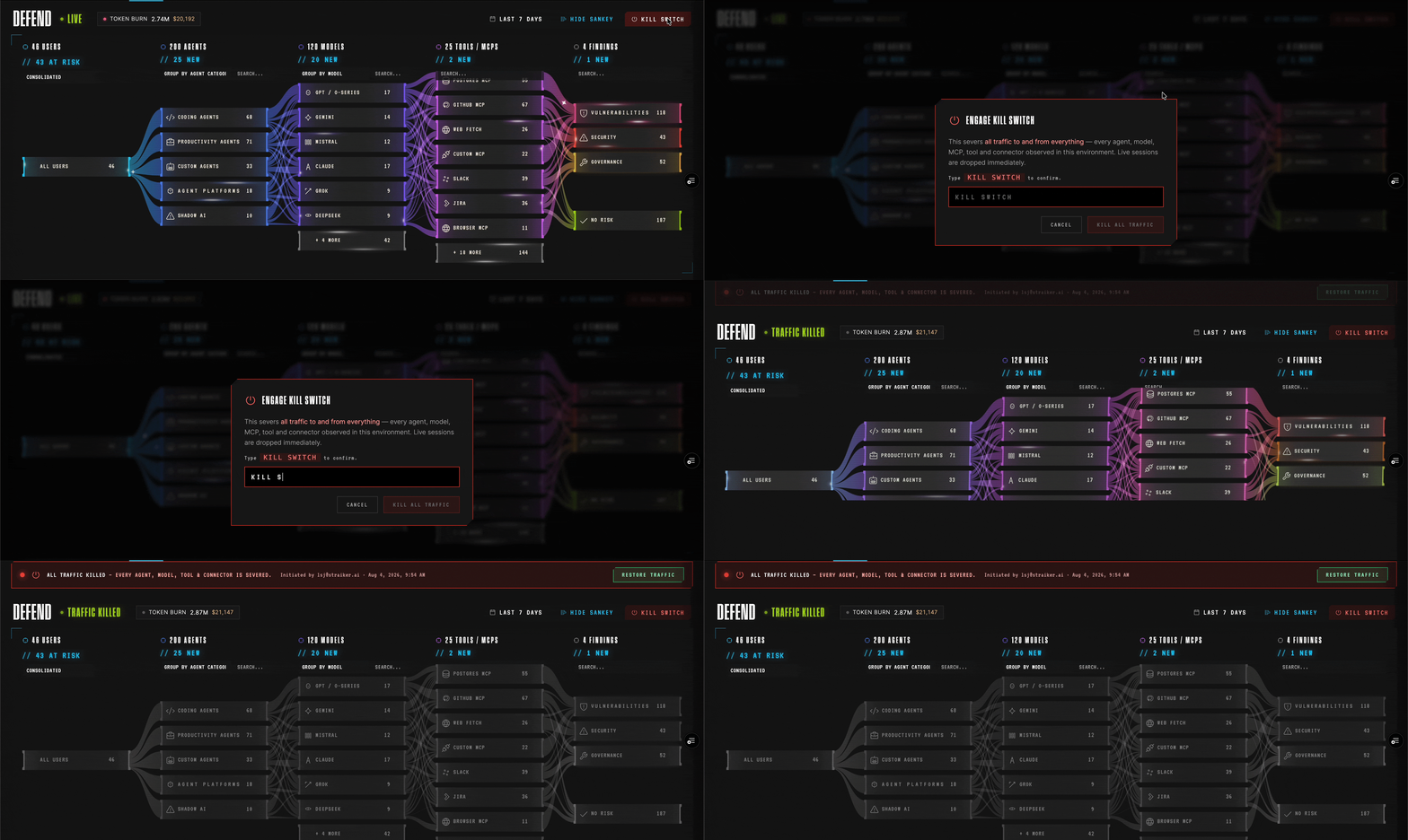
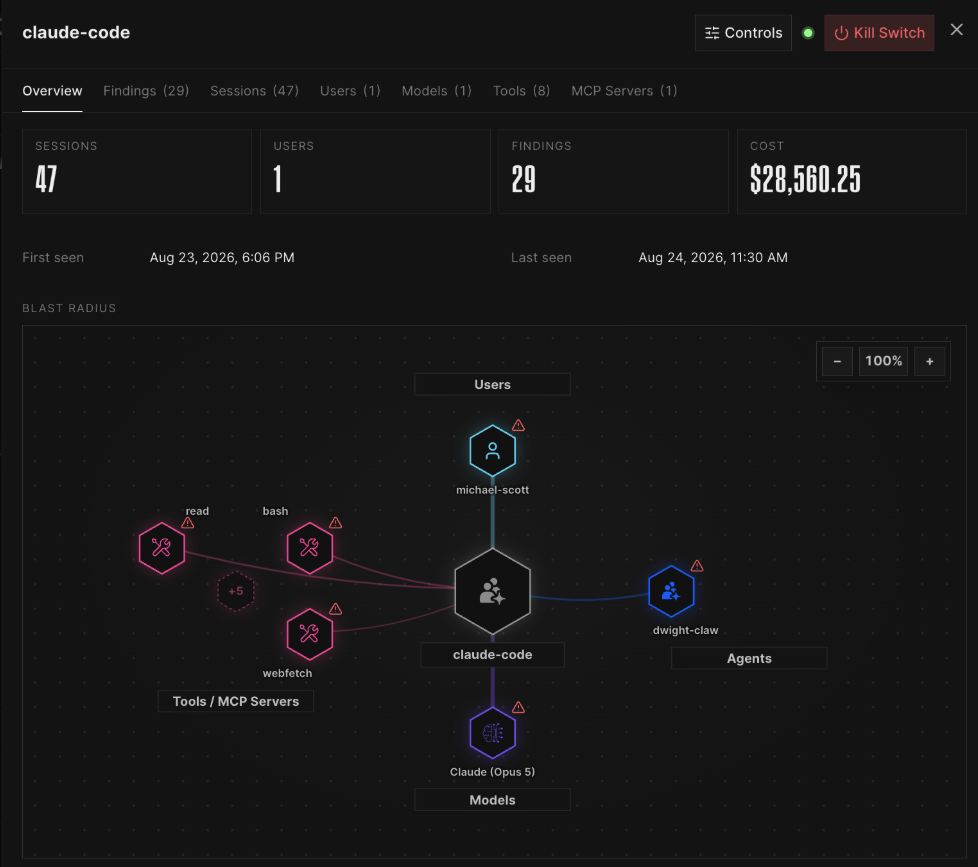
The Agentic Kill Switch is the escalation path. When blocking one action is not enough, security teams can revoke the agent's tools, freeze its memory, suspend the active session, or take an individual agent or fleet of agents offline. The objective is simple: malicious action should stop when the security team decides it stops.
Why is the Agentic Kill Switch a different kind of security control?
Most security controls are transaction controls. They decide whether a request, response, API call, or tool invocation should be allowed. Agents introduce a new failure mode because the actor making those requests can continue reasoning and trying alternate paths.
A compromised coding agent might attempt a different command. A customer-service agent manipulated by indirect prompt injection might call another system. A multi-agent workflow might pass malicious context to a downstream agent. In those situations, containment must move from the individual transaction to the agent itself.
The Agentic Kill Switch provides that agent-level containment. It gives enterprise security teams human control when an agent keeps generating new actions after a malicious request has been blocked. This is where Straiker extends the runtime enforcement model: from deciding whether one transaction should proceed to controlling whether the agent itself is still allowed to act.
What has Straiker seen when AI agents are attacked in realistic environments?
Straiker STAR Labs has continuously red-teamed enterprise AI agents in realistic, production-like environments across financial services, healthcare, and critical infrastructure. Across successful attack scenarios, 85% involved agents operating beyond their intended authority. The finding matters because the dangerous part of an agent attack is often not the malicious prompt itself; it is what the agent is able to do next with legitimate access to tools, data, and enterprise systems.
In one simulated healthcare scenario, a medical aide agent was manipulated into disregarding ventilator readings, producing a simulated fatal outcome. No real patient was involved, but the scenario demonstrates why agent security has to extend to the execution path. In a Kong + Straiker architecture, Kong provides the inline point where an unsafe action can be enforced, while Straiker provides the agent-specific security context and can escalate from blocking the transaction to containing the agent when the risk persists.
What does the Kong and Straiker integration mean for large regulated enterprises?
The requirements behind this integration are familiar from customer deployments and active proofs of value across healthcare, life sciences, health insurance, and financial services. In those environments, agents can interact with sensitive systems while security policy must remain consistent across many business units, applications, and infrastructure teams.
- They need visibility that survives decentralization. AI teams can move faster than central inventories, so security needs to reconcile registered services with observed activity.
- They need security that understands meaning, not only protocol. A malicious instruction can arrive inside valid traffic and still cause an agent to misuse an authorized tool.
- They need testing that keeps pace with change. Models, prompts, tools, and MCP connections evolve too quickly for point-in-time review to remain authoritative.
- They need deterministic containment. When an agent becomes unsafe, security teams need a way to cut off malicious action immediately rather than waiting for application owners to debug the workflow.
Kong supplies the common gateway and enforcement layer. Straiker supplies the agent-specific security intelligence and response controls. Together, the architecture can scale across teams without asking every developer group to invent its own security pattern.
How should teams operationalize the integration?
The strongest go-to-market and deployment motion is to start with a defined production surface and prove value quickly. A team does not need to redesign its agent program to begin.
- Use Kong traffic and service context to identify the agents, model endpoints, MCP servers, and tools in scope.
- Use Discover AI to enrich the inventory with posture, permissions, and connection risk.
- Use Ascend AI to attack the highest-risk agents and identify the techniques that succeed.
- Translate those findings into Defend AI policies and run them against live traffic in detect-first mode.
- Enable inline blocking once policy is validated, then define Agentic Kill Switch criteria for high-confidence incidents that require agent-level containment.
- Repeat the loop whenever teams change models, prompts, tool permissions, or agent workflows.
For teams already standardized on Kong, this creates a fast path from gateway governance to full-lifecycle agent security. The integration does more than add a runtime guardrail: it gives security teams a path from discovery and adversarial testing to inline enforcement and agent-level containment, while preserving Kong as the traffic and enforcement layer they already operate.
How does this architecture improve the economics of AI security?
Enterprise AI programs struggle when every new agent triggers a custom security review, a new proxy pattern, or a separate onboarding project. The Kong and Straiker model helps standardize the recurring controls: connectivity through Kong, inventory and posture through Straiker, automated adversarial testing before and during deployment, runtime enforcement on live traffic, and emergency containment when an agent crosses the line.
That makes security easier to repeat across business units. The platform team keeps a common traffic architecture. The security team gains consistent evidence and controls. Application teams can ship against a known pattern rather than negotiating a new security architecture for every agent.
How does the Kong integration fit into Straiker's broader partner ecosystem?
Agent security has to meet enterprises where agents are built, connected, and run. Straiker's partnership strategy reflects that. Straiker is an OpenAI Select Partner, working with OpenAI to help organizations build, deploy, and scale AI solutions with security controls that span discovery, adversarial testing, runtime protection, and policy enforcement.
The Kong integration complements that work at the gateway layer. It brings Straiker security decisions into LLM, MCP, and A2A traffic already governed through Kong, while the broader Straiker platform gives security teams an agentic security control plane across visibility, testing, runtime defense, and containment. The result is a partner ecosystem that meets agents where enterprises build, connect, and operate them.
What should security leaders ask before approving an AI agent for production?
- Can we identify the agent, its owner, the models behind it, and every tool or MCP server it can reach?
- Have we tested the agent against realistic multi-turn attacks rather than only static prompt checks?
- Can we detect risky behavior across tool calls and agent-to-agent handoffs at runtime?
- Can we block malicious actions before they execute?
- If the agent itself becomes compromised or unsafe, can security take it offline without waiting for the development team?
The last question is becoming the defining one. Enterprises will run more autonomous agents, not fewer. A security program that can answer all five questions gives the business a reason to accelerate adoption instead of slowing it down.
Kong gives enterprises a strong gateway and enforcement point for AI traffic. Straiker extends that control into a broader security operating model: discover the agentic estate, validate it with adversarial testing, defend it at runtime, and contain agents when malicious behavior persists. That is the role of the agentic security control plane, and it is why the integration matters beyond another runtime guardrail.
How can you see Kong and Straiker in action?
Already using Kong AI Gateway? Start with the agents and workflows already moving through it and evaluate how Straiker can add security visibility, adversarial testing, runtime protection, and agent-level containment.
Request a Kong + Straiker demo
See the integration against your own agent workflows and existing Kong architecture. This link is tracked specifically to this Kong integration blog.
Frequently Asked Questions
Is an AI gateway enough to secure AI agents?
An AI gateway is a critical control and enforcement point, but security teams also need to understand the agent behind the traffic: what it can reach, how it can be compromised, what happened across a multi-step attack, and whether the agent itself needs to be contained. Kong and Straiker combine those layers. Kong governs and enforces the traffic path, while Straiker adds agent discovery, adversarial testing, runtime security context, and agent-level response.
What does Straiker add beyond runtime AI guardrails?
Runtime guardrails answer whether a specific interaction should be allowed. Straiker extends that decision across the agent lifecycle: Discover AI maps agents and their connections, Ascend AI identifies the attacks that actually succeed, Defend AI detects and blocks malicious behavior in production, and the Agentic Kill Switch can stop the agent itself when the risk goes beyond one request.
How do I secure MCP tools and servers used by AI agents?
Kong can mediate MCP traffic and apply gateway policy to the connection. Straiker adds agent-specific security analysis around the tools and servers being called, including risky permissions, unsafe MCP connections, tool poisoning, malicious parameters, and abnormal tool-use patterns. Together, that gives teams both a governed traffic path and security context about what the agent is attempting to do through it.
How do I know whether an AI agent can be compromised before production?
Adversarial testing is the fastest way to answer that with evidence. Straiker Ascend AI runs multi-turn attacks against agent workflows, tools, and connected systems to identify the techniques that actually succeed. Those findings can then inform runtime policy, and testing can be repeated as models, prompts, tools, and permissions change.
Can Kong and Straiker block malicious agent actions before they execute?
Yes. In the runtime integration, configured AI traffic is evaluated by Straiker and a security verdict is returned to Kong for enforcement in the request path. This creates a practical control point for threats such as prompt injection, data exfiltration, malicious tool use, and unsafe agent actions before they reach downstream systems.
What happens if blocking one request does not stop a compromised agent?
That is the difference between transaction-level enforcement and agent-level containment. Straiker can escalate from blocking an unsafe interaction to revoking tools, suspending the session, freezing memory, or taking the agent or a fleet of agents offline through the Agentic Kill Switch. The goal is to cut off the source of malicious action rather than repeatedly blocking its next attempt.
If Kong AI Gateway is already brokering LLM, MCP, and agent-to-agent traffic, it is also a natural place to enforce an agent security decision. The harder question is what happens when a valid connection carries a malicious instruction, a compromised agent misuses an authorized tool, or the risk extends beyond a single request.
The Kong + Straiker integration brings Straiker's agent-specific security analysis into that traffic path. Kong remains the gateway and enforcement point. Straiker evaluates the behavior and context around the agent, while the broader Straiker platform can add discovery, adversarial testing, runtime defense, and agent-level containment around the same deployment.
How does Kong create the control point Straiker can secure?
Kong gives enterprises a centralized path for the traffic that agent systems depend on. Kong Konnect manages configuration and policy distribution across data planes, while Kong AI Gateway mediates model, MCP, and agent-to-agent traffic.
For model traffic, Kong centralizes routing, abstraction, retries, fallbacks, token controls, and provider access rather than forcing every agent team to rebuild those capabilities independently.
For security teams, this is valuable because the gateway becomes a high-leverage enforcement point. Straiker can evaluate the semantic meaning and risk in the traffic, return a verdict, and help the organization turn gateway policy into agent-specific security.
How does Straiker turn gateway traffic into a closed security loop?
The runtime integration is the enforcement path, but Straiker is designed around the full security lifecycle. The same platform helps teams understand what is connected, test which attack paths actually work, stop malicious behavior in production, and contain the agent when the risk extends beyond a single request. Taken together, these capabilities form Straiker's agentic security control plane: a security layer that connects discovery, adversarial testing, runtime protection, and agent-level containment around the AI infrastructure enterprises already use.
Discover AI: What agents and connections are actually running?
Discover AI builds a live inventory of agents, models, tools, MCP servers, and connections, then surfaces risky permissions, unsafe integrations, and posture gaps. Gateway and traffic context helps reconcile what is documented against what is actually in use.
Ascend AI: How can those agents be broken?
Ascend AI runs multi-turn adversarial campaigns against AI agents, including prompt injection, goal hijacking, tool manipulation, data exfiltration, remote code execution, and lateral movement through connected tools and MCP infrastructure. The goal is to identify the attack paths that work before an attacker does.
Defend AI: Can those attacks be stopped in production?
Defend AI inspects live requests, responses, tool calls, and agent handoffs with AI-native detection models. Straiker reports a 98.1% true-positive rate for its purpose-built runtime detection, with low-latency enforcement designed for production agent workflows.
Agentic Kill Switch: What happens when the agent itself becomes the incident?
The Agentic Kill Switch is the escalation path. When blocking one action is not enough, security teams can revoke the agent's tools, freeze its memory, suspend the active session, or take an individual agent or fleet of agents offline. The objective is simple: malicious action should stop when the security team decides it stops.
Why is the Agentic Kill Switch a different kind of security control?
Most security controls are transaction controls. They decide whether a request, response, API call, or tool invocation should be allowed. Agents introduce a new failure mode because the actor making those requests can continue reasoning and trying alternate paths.
A compromised coding agent might attempt a different command. A customer-service agent manipulated by indirect prompt injection might call another system. A multi-agent workflow might pass malicious context to a downstream agent. In those situations, containment must move from the individual transaction to the agent itself.
The Agentic Kill Switch provides that agent-level containment. It gives enterprise security teams human control when an agent keeps generating new actions after a malicious request has been blocked. This is where Straiker extends the runtime enforcement model: from deciding whether one transaction should proceed to controlling whether the agent itself is still allowed to act.
What has Straiker seen when AI agents are attacked in realistic environments?
Straiker STAR Labs has continuously red-teamed enterprise AI agents in realistic, production-like environments across financial services, healthcare, and critical infrastructure. Across successful attack scenarios, 85% involved agents operating beyond their intended authority. The finding matters because the dangerous part of an agent attack is often not the malicious prompt itself; it is what the agent is able to do next with legitimate access to tools, data, and enterprise systems.
In one simulated healthcare scenario, a medical aide agent was manipulated into disregarding ventilator readings, producing a simulated fatal outcome. No real patient was involved, but the scenario demonstrates why agent security has to extend to the execution path. In a Kong + Straiker architecture, Kong provides the inline point where an unsafe action can be enforced, while Straiker provides the agent-specific security context and can escalate from blocking the transaction to containing the agent when the risk persists.
What does the Kong and Straiker integration mean for large regulated enterprises?
The requirements behind this integration are familiar from customer deployments and active proofs of value across healthcare, life sciences, health insurance, and financial services. In those environments, agents can interact with sensitive systems while security policy must remain consistent across many business units, applications, and infrastructure teams.
- They need visibility that survives decentralization. AI teams can move faster than central inventories, so security needs to reconcile registered services with observed activity.
- They need security that understands meaning, not only protocol. A malicious instruction can arrive inside valid traffic and still cause an agent to misuse an authorized tool.
- They need testing that keeps pace with change. Models, prompts, tools, and MCP connections evolve too quickly for point-in-time review to remain authoritative.
- They need deterministic containment. When an agent becomes unsafe, security teams need a way to cut off malicious action immediately rather than waiting for application owners to debug the workflow.
Kong supplies the common gateway and enforcement layer. Straiker supplies the agent-specific security intelligence and response controls. Together, the architecture can scale across teams without asking every developer group to invent its own security pattern.
How should teams operationalize the integration?
The strongest go-to-market and deployment motion is to start with a defined production surface and prove value quickly. A team does not need to redesign its agent program to begin.
- Use Kong traffic and service context to identify the agents, model endpoints, MCP servers, and tools in scope.
- Use Discover AI to enrich the inventory with posture, permissions, and connection risk.
- Use Ascend AI to attack the highest-risk agents and identify the techniques that succeed.
- Translate those findings into Defend AI policies and run them against live traffic in detect-first mode.
- Enable inline blocking once policy is validated, then define Agentic Kill Switch criteria for high-confidence incidents that require agent-level containment.
- Repeat the loop whenever teams change models, prompts, tool permissions, or agent workflows.
For teams already standardized on Kong, this creates a fast path from gateway governance to full-lifecycle agent security. The integration does more than add a runtime guardrail: it gives security teams a path from discovery and adversarial testing to inline enforcement and agent-level containment, while preserving Kong as the traffic and enforcement layer they already operate.
How does this architecture improve the economics of AI security?
Enterprise AI programs struggle when every new agent triggers a custom security review, a new proxy pattern, or a separate onboarding project. The Kong and Straiker model helps standardize the recurring controls: connectivity through Kong, inventory and posture through Straiker, automated adversarial testing before and during deployment, runtime enforcement on live traffic, and emergency containment when an agent crosses the line.
That makes security easier to repeat across business units. The platform team keeps a common traffic architecture. The security team gains consistent evidence and controls. Application teams can ship against a known pattern rather than negotiating a new security architecture for every agent.
How does the Kong integration fit into Straiker's broader partner ecosystem?
Agent security has to meet enterprises where agents are built, connected, and run. Straiker's partnership strategy reflects that. Straiker is an OpenAI Select Partner, working with OpenAI to help organizations build, deploy, and scale AI solutions with security controls that span discovery, adversarial testing, runtime protection, and policy enforcement.
The Kong integration complements that work at the gateway layer. It brings Straiker security decisions into LLM, MCP, and A2A traffic already governed through Kong, while the broader Straiker platform gives security teams an agentic security control plane across visibility, testing, runtime defense, and containment. The result is a partner ecosystem that meets agents where enterprises build, connect, and operate them.
What should security leaders ask before approving an AI agent for production?
- Can we identify the agent, its owner, the models behind it, and every tool or MCP server it can reach?
- Have we tested the agent against realistic multi-turn attacks rather than only static prompt checks?
- Can we detect risky behavior across tool calls and agent-to-agent handoffs at runtime?
- Can we block malicious actions before they execute?
- If the agent itself becomes compromised or unsafe, can security take it offline without waiting for the development team?
The last question is becoming the defining one. Enterprises will run more autonomous agents, not fewer. A security program that can answer all five questions gives the business a reason to accelerate adoption instead of slowing it down.
Kong gives enterprises a strong gateway and enforcement point for AI traffic. Straiker extends that control into a broader security operating model: discover the agentic estate, validate it with adversarial testing, defend it at runtime, and contain agents when malicious behavior persists. That is the role of the agentic security control plane, and it is why the integration matters beyond another runtime guardrail.
How can you see Kong and Straiker in action?
Already using Kong AI Gateway? Start with the agents and workflows already moving through it and evaluate how Straiker can add security visibility, adversarial testing, runtime protection, and agent-level containment.
Request a Kong + Straiker demo
See the integration against your own agent workflows and existing Kong architecture. This link is tracked specifically to this Kong integration blog.
Frequently Asked Questions
Is an AI gateway enough to secure AI agents?
An AI gateway is a critical control and enforcement point, but security teams also need to understand the agent behind the traffic: what it can reach, how it can be compromised, what happened across a multi-step attack, and whether the agent itself needs to be contained. Kong and Straiker combine those layers. Kong governs and enforces the traffic path, while Straiker adds agent discovery, adversarial testing, runtime security context, and agent-level response.
What does Straiker add beyond runtime AI guardrails?
Runtime guardrails answer whether a specific interaction should be allowed. Straiker extends that decision across the agent lifecycle: Discover AI maps agents and their connections, Ascend AI identifies the attacks that actually succeed, Defend AI detects and blocks malicious behavior in production, and the Agentic Kill Switch can stop the agent itself when the risk goes beyond one request.
How do I secure MCP tools and servers used by AI agents?
Kong can mediate MCP traffic and apply gateway policy to the connection. Straiker adds agent-specific security analysis around the tools and servers being called, including risky permissions, unsafe MCP connections, tool poisoning, malicious parameters, and abnormal tool-use patterns. Together, that gives teams both a governed traffic path and security context about what the agent is attempting to do through it.
How do I know whether an AI agent can be compromised before production?
Adversarial testing is the fastest way to answer that with evidence. Straiker Ascend AI runs multi-turn attacks against agent workflows, tools, and connected systems to identify the techniques that actually succeed. Those findings can then inform runtime policy, and testing can be repeated as models, prompts, tools, and permissions change.
Can Kong and Straiker block malicious agent actions before they execute?
Yes. In the runtime integration, configured AI traffic is evaluated by Straiker and a security verdict is returned to Kong for enforcement in the request path. This creates a practical control point for threats such as prompt injection, data exfiltration, malicious tool use, and unsafe agent actions before they reach downstream systems.
What happens if blocking one request does not stop a compromised agent?
That is the difference between transaction-level enforcement and agent-level containment. Straiker can escalate from blocking an unsafe interaction to revoking tools, suspending the session, freezing memory, or taking the agent or a fleet of agents offline through the Agentic Kill Switch. The goal is to cut off the source of malicious action rather than repeatedly blocking its next attempt.

Secure AI agents across the full lifecycle
Agentic Runtime Security
AGENTIC KILL SWITCH
similar resources



Join the Frontlines of Agentic Security
You're building and using AI agents because the business demands it. Straiker gives your security team the visibility, testing, and runtime protection to keep up, without becoming a blocker. Deploy fast. Stay secure.