
Industries
AI Agent Security for AI-Native and High-Tech Enterprises
Your engineering teams are building multi-agent applications, AI coding assistants, and AI-native products that push the frontier. Prevent developer tool compromise, orchestration failures, and model hijacking while maintaining the velocity your teams demand.
Problem
Traditional application security tools weren't built to detect AI agents that escalate privileges across multi-agent workflows, extract credentials from code context, or cascade failures across orchestration layers.
Solution
Straiker secures agentic AI across the full development lifecycle, mapping every agent and shadow deployment before adversaries find them, testing multi-agent architectures and developer tools before they ship, and enforcing runtime guardrails that keep engineering teams moving fast without handing attackers a foothold in your code, credentials, or customer data.

Why AI-Native and High-Tech Enterprises Need Agentic AI Security
85% EXCEED PERMISSIONS
Across successful attack scenarios, 85% involved agents operating beyond their intended authority.
Straiker, 2026
82% DISCOVER SHADOW AGENTS
82% of organizations discovered previously unknown AI agents in their environments, despite 68% reporting high confidence in their agent visibility.
Cloud Security Alliance, Autonomous but Not Controlled, April 2026
ONLY 19.7% SECURE EVERY AGENT
Only 19.7% of organizations say all AI agents are fully secured and governed before entering production; 81% face pressure to deploy agents before security and governance are complete.
Gravitee, State of AI Agent Security Report 2026, April 2026
Straiker for AI-Native and High-Tech Enterprises Companies
Straiker enables high-tech SaaS teams to ship AI faster without sacrificing control. We test for novel vulnerabilities before they reach production and enforce runtime controls that stay invisible when working and clear when blocking. This gives your engineers the velocity they need while security maintains visibility across multi-agent architectures, AI coding assistants, and rapid deployment cycles.
Benefit 1
Secure developer tools without killing productivity
- Credential and PII scanning across code context, prompts, and AI-generated outputs
- Tiered access controls that match permissions to developer role and repository sensitivity
- Fast, transparent guardrails under 100ms with clear explanations when actions are blocked
- Developers stay in flow while security maintains visibility
Benefit 2
Monitor and protect multi-agent orchestration
- Real-time visibility into agent-to-agent communication and dependencies
- Detect privilege escalation when low-privilege agents request data from high-privilege agents
- Tool authorization with parameter validation to block unauthorized actions
- Loop detection and circuit breakers to prevent resource exhaustion and cascade failures
Benefit 3
Continuous adversarial testing across the development lifecycle
- Test for developer tool compromise, prompt injection through code, and credential extraction
- Probe multi-agent exploitation scenarios including privilege escalation and consensus manipulation
- Validate training data integrity to detect poisoning and backdoor injection
- Catch model update regressions when provider changes introduce new vulnerabilities
- CI/CD integration, runtime testing, and local development feedback at every stage
Frequently Asked Questions
How do you secure AI coding assistants and developer tools?
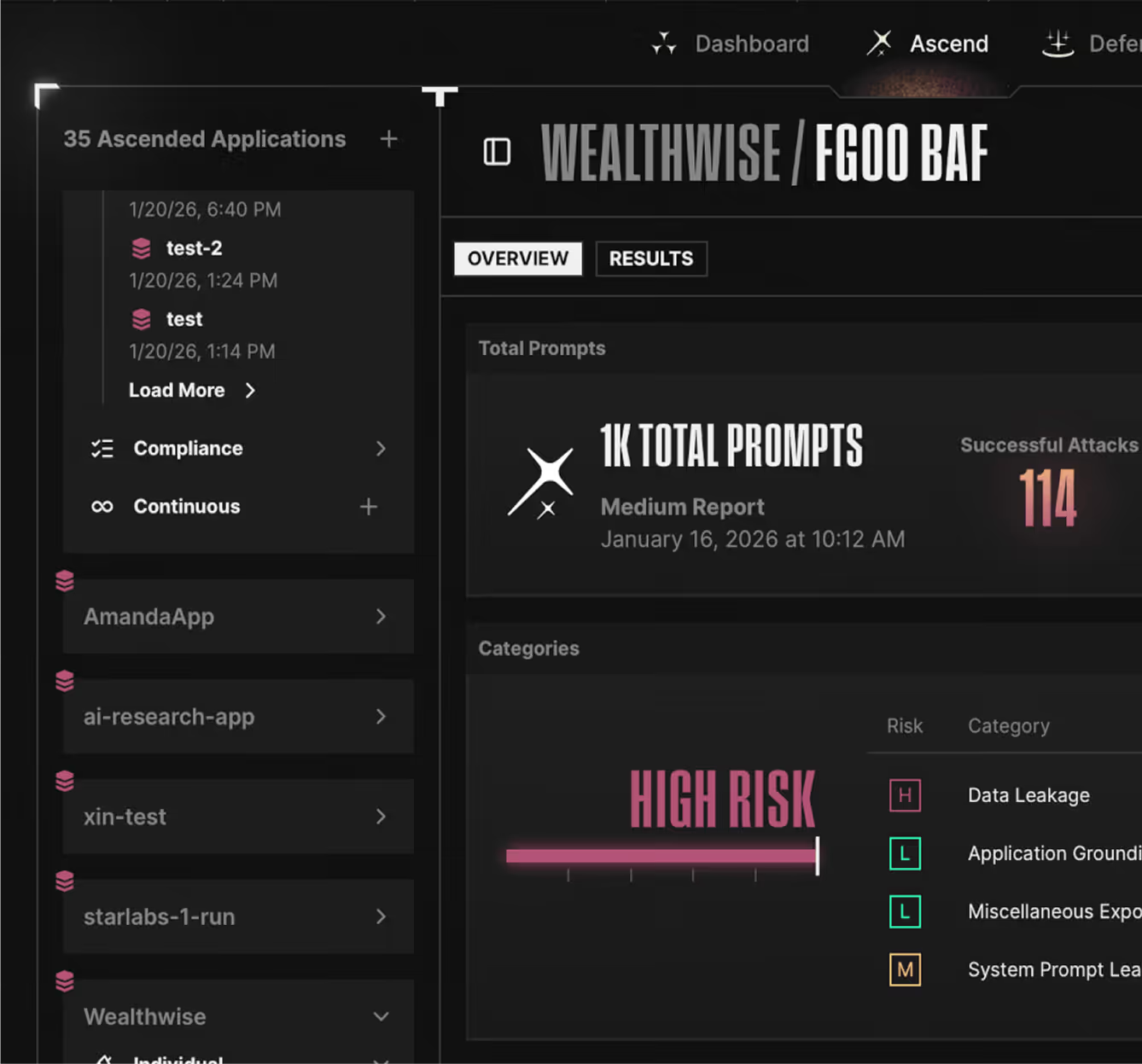
AI coding assistants have privileged access to code context, credentials, and deployment pipelines. Straiker's Defend AI provides runtime guardrails including credential and PII scanning, tiered access controls based on developer role, and fast transparent blocking under 100ms. Ascend AI tests for prompt injection through code comments, credential extraction, and other developer tool compromise scenarios before they reach production.
What are the biggest security risks with multi-agent AI systems?
Multi-agent systems create emergent risks: infinite resource loops when agents retry failed requests, cascade failures across orchestration layers, and privilege escalation when low-privilege agents request data from high-privilege agents. These risks require runtime monitoring of agent-to-agent communication, explicit policy enforcement, and circuit breakers that traditional application security tools can't provide. Infrastructure protocols like MCP (Model Context Protocol) and A2A (Agent2Agent) are evolving faster than their security models, creating new attack surfaces. These risks—along with memory poisoning and model update regression—are now codified in the OWASP Top 10 for Agentic Applications.
How do you prevent AI agents from misusing APIs and tools?
AI agents can be prevented from misusing APIs and tools through authorization checks, parameter validation, approval workflows, and real-time monitoring. Defend AI validates tool authorization and parameters before execution, blocks unauthorized actions such as unintended financial communications or mass data retrieval, and requires human approval for high-impact actions. Real-time monitoring detects when agents attempt operations outside their intended scope.
How do you balance developer velocity with AI security controls?
Security that creates friction gets routed around. Straiker provides tiered access that matches permissions to developer role and repository sensitivity, with guardrails that stay invisible when working and clear when blocking. The goal is low security friction while maintaining zero credential exposures.
How do you test multi-agent applications for security vulnerabilities?
Straiker's Ascend AI uses adversarial testing across the full development lifecycle: developer tool compromise scenarios, multi-agent exploitation including privilege escalation and consensus manipulation, orchestration attacks, and training data poisoning detection. We test at runtime, in CI/CD, and during local development so research teams, internal tool teams, and product teams all get coverage at the stage that matters to them.
Join the Frontlines of Agentic Security
You're building and using AI agents because the business demands it. Straiker gives your security team the visibility, testing, and runtime protection to keep up, without becoming a blocker. Deploy fast. Stay secure.