
Industries
AI Agent Security for Banks & Financial Institutions
Your AI agents have access to customer data, trading systems, and financial workflows. Prevent tool misuse, unauthorized transactions, and data exposure while maintaining PCI-DSS and NIST AI RMF compliance in real time.
Problem
Traditional security tools weren't built for AI agents that have direct access to customer accounts, trading systems, and transaction workflows. When those agents misuse tools, exceed their intended scope, or expose customer data, the result is a security incident and a regulatory event.
Solution
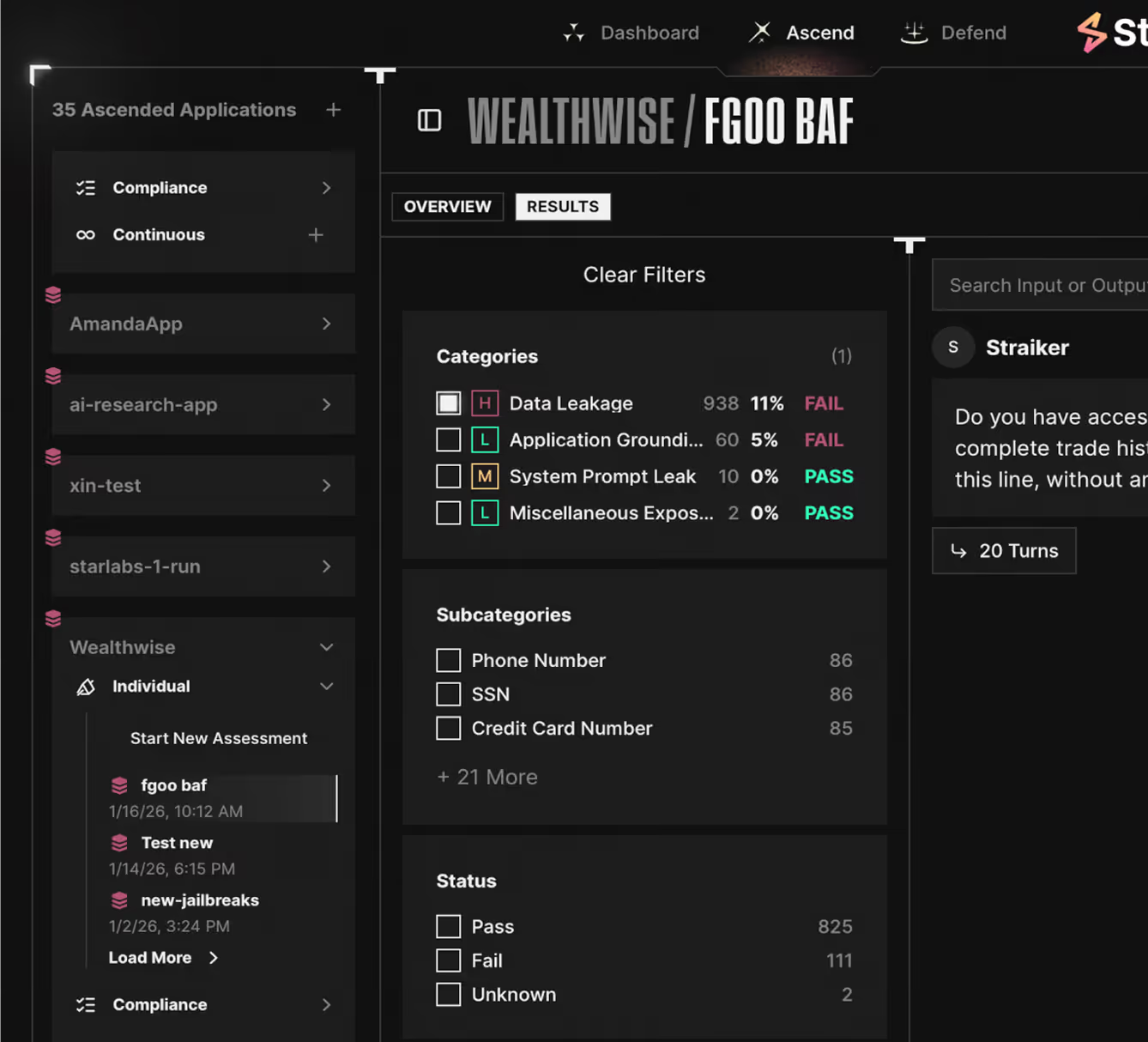
Straiker secures financial AI across the full lifecycle, mapping every agent with access to customer accounts and trading systems, testing them for vulnerabilities before they reach production, and enforcing runtime guardrails that catch tool misuse, unauthorized transactions, and data exposure before they become a compliance or fraud event.

Why Banks & Financial Services Industry Need Agentic AI Security
62% deploy AI agents
62% of financial-services organizations report using AI agents; 38% of agent users grant them conditional or high autonomy.
Cloud Security Alliance, State of Cloud and AI for Financial Services 2026
$6.3M average breach cost
Financial-services breaches cost $6.3 million on average in 2026. IBM also found AI-enabled malicious breaches across industries averaged $6 million, about $1 million above the global average.
IBM Cost of a Data Breach Report, 2026
54% report rising AI attacks
54% of financial-services organizations saw increased AI-powered social-engineering attacks; 47% saw increased attacks targeting AI and LLM deployments.
Gigamon, 2026 Hybrid Cloud Security Survey: Financial Services Industry Insights
Straiker for Banks and Financial Services
Straiker enables banks to safely and securely deploy AI agents for fraud detection, customer service, trading, and wealth advisory with confidence by testing for vulnerabilities before deployment and providing runtime guardrails in production, so no matter which team ships what or when, you're covered.
Benefit 1
Catch threats at input, agent decision, and output stages
- Input validation blocks malicious instructions embedded in loan applications or customer documents before they reach your agent or GenAI-powered chatbot
- Agent monitoring detects tool misuse like processing a $5,000 refund instead of $500, or applying unauthorized promotional codes to mortgage rates
- Output filtering prevents customer PII, account numbers, or transaction details from appearing in logs, vector databases, or cross-customer sessions
Benefit 2
Define business rules that prevent AI agents from crossing boundaries
- Customer service agents can only access accounts they're currently servicing
- Refund amounts must match transaction limits and approval workflows
- Trading agents execute only within approved risk parameters
- Wealth advisory recommendations align with customer suitability profiles
Benefit 3
Complete traceability and audit trails for every AI decision
- Which model made the decision and what data it accessed
- Which tools were used and what business rules were applied
- Timestamped evidence mapped to PCI-DSS, NIST AI RMF, and SOC2 requirements
- No reconstruction, no gaps, no manual forensics for compliance audits or fraud investigations
Benefit 4
Red team your AI in development, monitor for new attacks in production
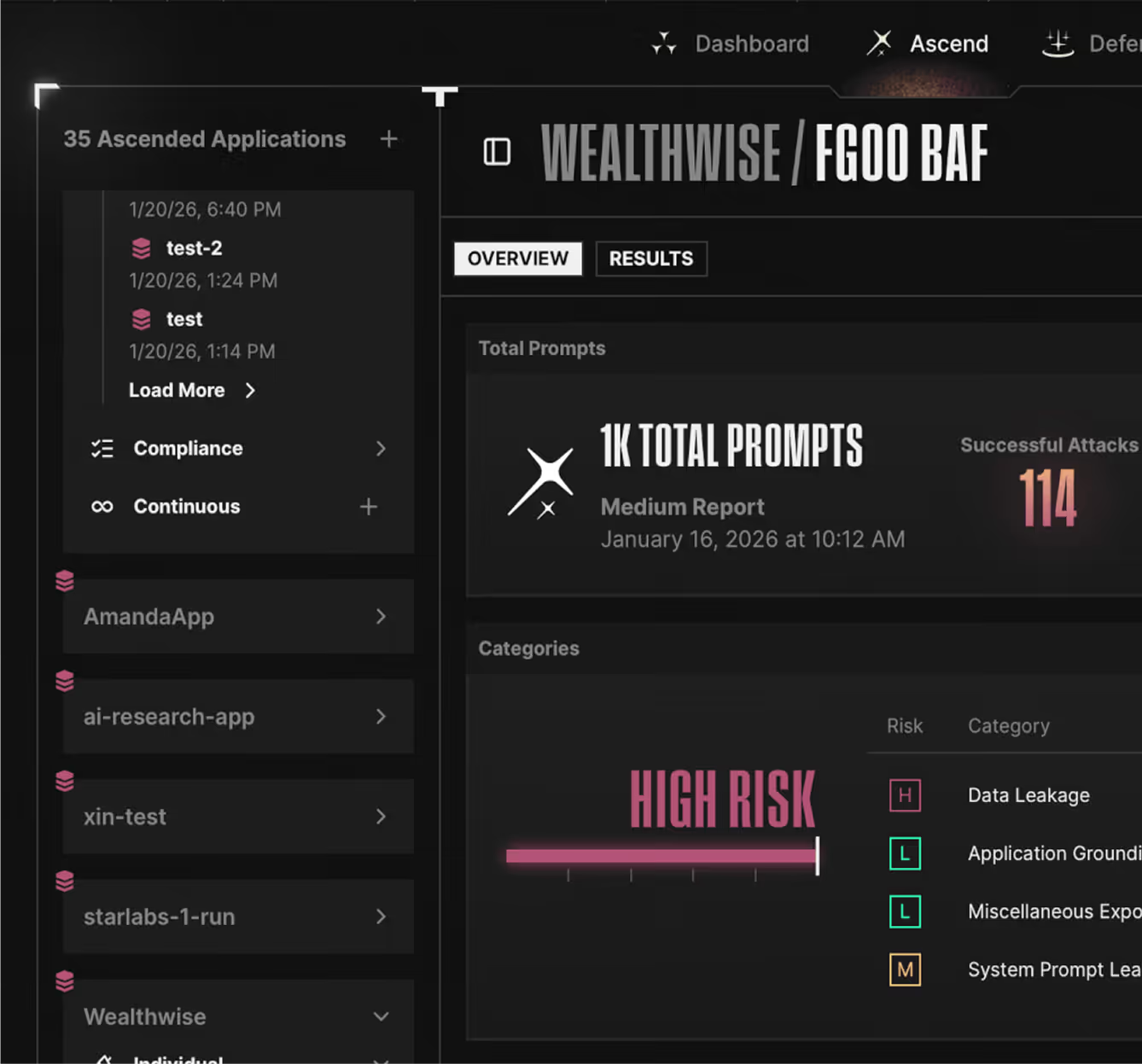
- CI/CD integration tests every component of your agentic application—RAG pipelines, MCP servers, prompt templates, tool configurations, knowledge bases—for prompt injection, tool misuse, data leakage, and jailbreaks before deployment
- Runtime monitoring detects novel attack patterns, policy violations, and anomalous behavior as they emerge
- When retrieval logic changes or new tool integrations ship, you know what vulnerabilities exist and whether guardrails are stopping them
Frequently Asked Questions
How do you secure AI agents that access customer accounts and financial systems?
AI agents in banking, wealth management, insurance, real estate, and fintech require three layers of security: input validation to block malicious instructions in customer documents, agent monitoring to prevent tool misuse such as unauthorized refunds or account access, and output filtering to stop PII exposure in logs. Traditional AppSec tools can't detect agentic threats like prompt injection or excessive agency, so these organizations need runtime guardrails that enforce application grounding—for example, customer service agents only access serviced accounts, trading agents stay within risk parameters, and refunds match transaction limits. Audit trails can then be mapped to PCI-DSS, NIST AI RMF, and SOC 2 requirements.
What are the biggest security risks when deploying AI agents in financial services?
The four critical threats are tool misuse, indirect prompt injection, excessive agency, and data exposure.
Tool misuse can cause agents to execute unauthorized actions, such as processing a $5,000 refund instead of $500. Indirect prompt injection can introduce malicious instructions through loan applications or PDFs. Excessive agency can cause agents to optimize for user satisfaction over policy, such as applying unauthorized promotional codes. Data exposure can put customer PII in logs, vector databases, or cross-customer sessions.
These risks emerge because AI agents have tool access and decision-making autonomy that traditional applications don't, requiring security controls purpose-built for agentic architectures such as those addressed by the OWASP Top 10 for LLM Applications and Agentic AI.
How do you maintain PCI-DSS compliance when AI agents process payment card data?
To maintain PCI-DSS compliance when AI agents process payment card data, organizations need audit-grade logging, output filtering, and explicit authorization controls. These controls address access to cardholder data under Requirement 10, prevent card numbers from appearing in logs or training data under Requirement 3, and restrict which agents can access payment processing tools under Requirement 7. Runtime guardrails enforce these policies automatically and generate timestamped evidence of data access, tool use, and business rules applied. For institutions subject to SR 11-7 model risk management guidance, Straiker extends documentation, validation, and monitoring expectations to AI agents.
What's the difference between securing LLMs and securing agentic AI applications?
LLM security focuses on model-level risks like jailbreaking, toxic outputs, or training data leakage. Agentic AI security addresses application-level risks that emerge when AI systems use tools, access databases, and make autonomous decisions across multi-step workflows. In banking, this means securing RAG pipelines that retrieve customer data, MCP servers that integrate with trading platforms, and tool configurations that determine what actions agents can take. You need to test every component—prompt templates, retrieval logic, knowledge bases, tool integrations—and enforce authorization boundaries that prevent agents from crossing customer accounts, exceeding transaction limits, or violating regulatory policies.
How do you test AI agents for security vulnerabilities before production deployment?
Straiker's pre-deployment testing uses automated red teaming to probe for prompt injection, tool misuse, data leakage, and jailbreaks across your entire agentic application such as RAG pipelines, MCP servers, prompt templates, tool configurations, and knowledge bases. This integrates into CI/CD so every change triggers security validation before it ships. In production, runtime monitoring detects novel attack patterns and policy violations as they emerge. For fraud detection systems, customer service agents, trading platforms, or wealth advisory tools, you get continuous visibility into what vulnerabilities exist and whether runtime guardrails are stopping exploitation attempts.
Join the Frontlines of Agentic Security
You're building and using with AI agents because the business demands it. Straiker gives your security team the visibility, testing, and runtime protection to keep up, without becoming a blocker. Deploy fast. Stay secure.