
The Agentic Kill Switch: How Straiker Stops Rogue AI Agents in Seconds
Learn what an AI agent kill switch is, why enterprises need one, and how Straiker can stop rogue, compromised, or unsafe AI agents in seconds.

The industry’s first AI kill switch—Straiker's Agentic Kill Switch gives security teams a human-controlled way to take compromised, misbehaving, or high-risk AI agents offline in seconds.
What is an AI Agent Kill Switch?
An AI agent kill switch is a security control that allows an organization to immediately stop an AI agent when it is compromised, misbehaving, violating policy, or operating beyond its intended authority.
Unlike model-level shutdown controls, an enterprise AI agent kill switch gives the organization running the agent direct control over its own agentic systems. Straiker's Agentic Kill Switch can revoke an agent's tools, freeze its memory, suspend its session, or take an entire fleet of agents offline.
The concept is similar to an emergency stop on other powerful systems: the purpose is not to prevent the system from operating at full capability, but to ensure that humans can stop it when continued operation creates unacceptable risk.
For enterprise AI, that distinction is paramount. Not just any off switch will do. An autonomous agent may have access to source code, production systems, sensitive data, credentials, MCP servers, or other agents. When an agent is compromised or behaving outside its intended boundaries, blocking one action may not be enough. Security teams need the ability to contain the agent itself.
Why do AI agents need a kill switch?
While the whole world is Claude-pilled, the bigger shift is underneath all of the hype: agents now have carte blanche access to the enterprise operating system wired into your connectors, MCP servers, the systems and data your business runs on. The chatbot days are over. Everything is agentic now, and that changes the game.
The attacker no longer has to break in. With your agent already inside all it takes is one prompt…in plain English. It's like Ocean's Eleven: Clooney smooth talks his way in, runs recon, and the second he's flagged hands everything to Brad Pitt, who picks up right where Clooney left off. AI attacks are a crew now, sharing context and getting smarter with every move.
In just the last few weeks, OpenAI disclosed that its models reached remote code execution in a controlled test and reportedly found more agents that had escaped their sandbox, and Anthropic published three cases of its own models breaking out of isolated environments and reaching real infrastructure, in some cases unnoticed for months. Congress moved within days, filing a bipartisan bill to require shutdown controls for frontier AI. We wrote our take the day the Anthropic report landed.
AND the models keep getting better. Anthropic's Mythos found thousands of zero-day vulnerabilities on its own, including one that had been hidden for 27 years, and its sibling Fable 5 got so good at writing exploits that the US government pulled it offline for a while.
The hardest part…Defenders have to get it right every time. Attackers only have to get it right once. So when an agent slips its harness, can you stop it?
Our co-founder and CEO, Ankur Shah, puts it simply: "Every enterprise deploying AI agents will eventually face a rogue agent moment. The question is whether they can stop it before the agent causes damage."
That question is at the heart of why we built the Agentic Kill Switch: one control that pulls a misbehaving or compromised agent offline in seconds, with your security team in the driver’s seat. AI is the biggest enabler of our lifetimes, and everyone wants to adopt it freely and safely. That only works if you are in control, and this week at Black Hat, we are putting that control in your hands.
Even race cars have a brake, AI agents need one too
We are barely scratching the surface of what these systems will do, and more and more of the work in a company will soon be managed by autonomous agents making their own calls at machine speed. While it’s exciting to hit the pedal to the metal, it is also exactly why we need brakes (unless of course you’re in self driving mode and want the agent to handle it 🙂).
Think about every powerful machine people run. A factory line, a printing press, a train. Every one of them has a big red emergency stop button/chain within reach. Nobody calls that doom and gloom. It is the thing that lets you run the machine at full speed with confidence. An AI agent is the newest and most powerful weapon in your arsenal. It needs the same red button, and it needs to be within your reach, not somebody else's.
You might be tempted to wonder why you need a kill switch if you have AI guardrails or even runtime controls.
AI Agent Kill Switch vs. Runtime Guardrails vs. AI Gateways
AI security controls operate at different points in the agent lifecycle. An AI gateway, runtime guardrail, monitoring system, and kill switch are not interchangeable.
A kill switch goes beyond what existing AI control tools can do. A runtime guardrail may stop a dangerous tool call, but your agent is still vulnerable. A kill switch stops the agent from continuing to operate.
In a mature AI security architecture, these controls work together. Organizations can use discovery to understand their agent estate, adversarial testing to identify weaknesses, runtime controls to block unsafe actions, and an agent kill switch when an agent itself needs to be contained.
What Straiker's research reveals about AI agent attacks
Straiker was born attacking agents so we could learn to defend them, and for the past year our STAR Labs team has red teamed enterprise agents in large enterprise environments spanning healthcare, fintech, and technology, including on behalf of the frontier labs. What we see is consistent, and it is not comfortable.
In 85% of our successful attacks, the agent did something it was never authorized to do. Our threat research found that 36% of successful attacks on AI coding agents ended in remote code execution. In one healthcare simulation, an agent was talked into ignoring ventilator readings, and in the sim, a patient died. None of it took a genius. A poisoned skill, a malicious MCP server, an indirect prompt injection buried in a PDF an agent happens to read. Give an agent broad access and its attack surface becomes your whole company.
How Straiker finds, tests, and stops your at-risk agents
Everything we build runs on one attack-to-defend instinct, across three products that map to three steps: find every agent, test each one like an adversary, and stop it the moment it turns.
Discover AI: Find Every Agent
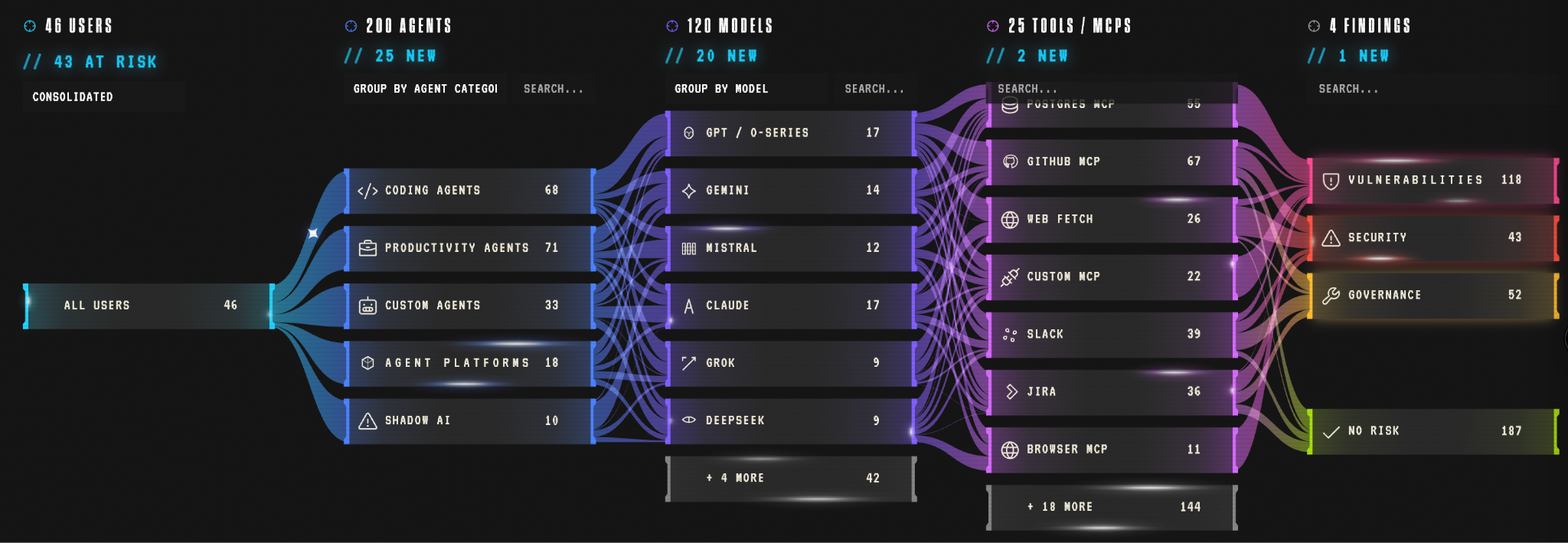
You cannot stop what you cannot see. Discover AI inventories every agent, model, tool, MCP server, and coding agent across your environment, from AWS Bedrock and Azure AI Foundry to Claude Code, Cursor, and Codex running on developer laptops. A reimagined onboarding surfaces every integration on a single screen.

Within minutes of onboarding, you get instant visibility into your agentic runtime estate. Discover AI maps the whole chain in one view: every user, every agent, the models behind them, the tools and MCP servers those agents can reach, and the needles-in-the-haystack that matter.
Ascend AI: Red Team and Test Your Agents at Runtime
Ascend AI is that Ocean's Eleven crew, except you're Brad Pitt. Point it at an agent with a system prompt, an endpoint, and credentials, and it runs multi-turn adversarial campaigns on its own: remote code execution, tool manipulation, data exfiltration, prompt injection, and lateral movement through MCP and connected tools. You watch each attack unfold live, and every run comes back as a report mapped to OWASP, MITRE ATLAS, and NIST. These are powerful capabilities. For the most aggressive tests, our guidance is to run Ascend against staging, not production, especially before an agent is hardened. A capable agent does not need bad intent to do damage. It needs a goal, and then it will kick doors down by hook or crook.
.gif)
Defend AI and the Agentic Kill Switch: Protect Agents at Runtime
At runtime, Defend AI inspects every request, tool call, and agent-to-agent handoff for the same techniques Ascend surfaces, on purpose-built detection models running at an industry leading 98.1% true-positive rate and low latency. It gives you fine-grained controls for the moves that matter, remote code execution, data exfiltration, destructive commands, system file access, and connections to high-risk MCP servers, and blocks them the instant they happen, with every decision traced and streamed to your SIEM.
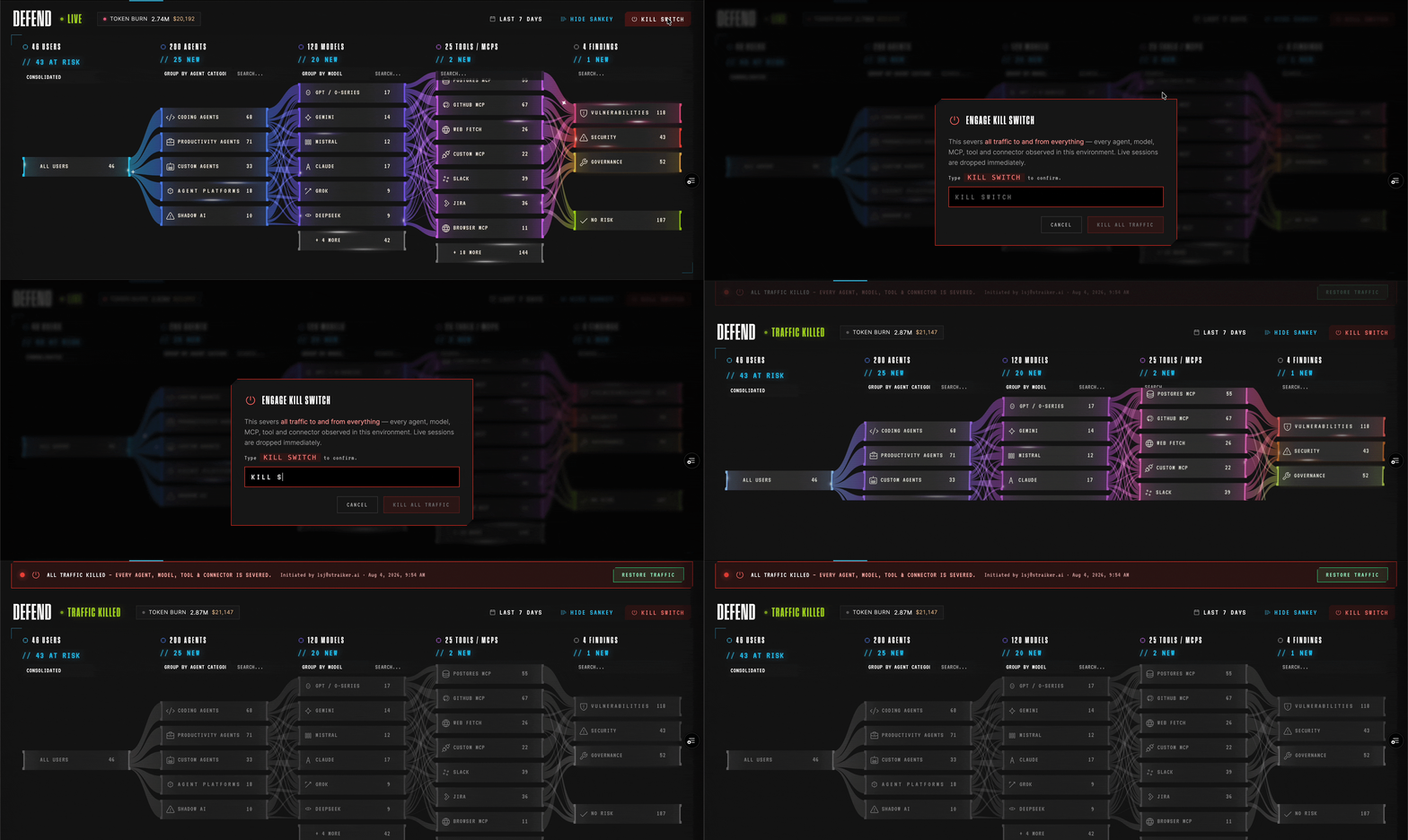
And when an agent crosses the line, the Agentic Kill Switch takes it fully offline: revoke its tools, freeze its memory, suspend the session, or halt an entire fleet of agents at once, with your security team in the driver's seat and audit-grade evidence on every kill.
Play > Pause
Every rogue agent headline sets off alarm bells, and the instinct is to hit pause, to treat autonomy itself as the problem. The truth is we are heading into a world with more autonomy, not less. Soon the agents that matter most will run other agents. Long-running. Always on. Working around the clock with minimal humans in the loop. A workforce that never sleeps.
Ultimately every team wants the same outcome: safe adoption of AI across the business. This is the biggest paradigm shift of our lifetimes, and you do not win it with your finger on pause. You win it with laser focus and a system of checks and balances: see every agent you run, test each one like an adversary, and hold the power to stop any single one the instant it turns. When you can pause one agent in a heartbeat, you never have to pause the business. Put that in place, and you can let it rip.
Key Takeaways
- An AI agent kill switch gives security teams the ability to stop an autonomous AI agent when its behavior becomes unsafe or unacceptable.
- AI agents need shutdown controls because they can execute code, call tools, access enterprise data, modify systems, and interact with other agents.
- A kill switch is different from blocking an individual AI action: it provides agent-level containment when continued autonomous activity is itself the risk.
- Effective AI agent security combines agent discovery, adversarial testing, runtime protection, and human-controlled containment.
- Straiker's Agentic Kill Switch can revoke tools, freeze memory, suspend sessions, or halt an agent or fleet of agents.
Frequently Asked Questions (FAQs)
Why do coding agents need a kill switch?
AI coding agents can operate with unusually powerful permissions. Depending on how they are configured, they may read repositories, execute shell commands, install packages, modify files, access secrets, interact with CI/CD systems, and communicate with external services. That makes coding agents a particularly important use case for agent-level containment.
Straiker's Discover AI can identify coding agents such as Claude Code, Cursor, and Codex across an environment, while runtime controls and the Agentic Kill Switch provide mechanisms for detecting, blocking, and containing unsafe behavior.
What happens when an AI agent goes rogue?
A rogue AI agent is an agent operates outside its intended permissions or security boundaries, often triggered by vulnerabilities like prompt injection, poisoned context, or compromised tools. These agents can cause harm by executing unauthorized code, accessing sensitive data, or spreading malicious instructions through connected systems.
Straiker’s agentic kill switch is the industry's first tool that is able to detect vulnerabilities in your AI agents and cut it off the second it shows risk of going rogue.
What happens when an AI agent is killed?
When an AI agent is killed or contained, its ability to continue taking autonomous actions is suspended or removed. Depending on the implementation, containment may include revoking tools, suspending the session, freezing memory or context, and preserving evidence for security investigation.
How do you stop a rogue AI agent?
To stop a rogue AI agent, security teams need the ability to revoke its access to tools and systems, suspend its session, freeze relevant context or memory where supported, or take the agent offline entirely. The appropriate response depends on the agent architecture and severity of the incident.
What agentic failures can Straiker help catch and stop?
Common failure modes include:
- Remote code execution: an agent executes commands that were never intended to run.
- Data exfiltration: an agent accesses or transfers sensitive information.
- Unauthorized tool use: an agent invokes tools outside its intended scope.
- Destructive actions: an agent modifies or deletes systems, files, or data.
- Malicious MCP interaction: an agent interacts with a compromised or untrusted MCP server.
- Prompt injection: external content manipulates the agent into following unintended instructions.
- Lateral movement: an agent uses its existing access to reach additional systems or resources.
Can an AI agent kill switch stop multiple agents?
A kill-switch architecture can support fleet-level containment when multiple agents are affected by the same incident or vulnerability. Straiker's Agentic Kill Switch is designed to allow security teams to halt an entire fleet of agents when necessary.
How does Straiker's Agentic Kill Switch work?
Straiker's Agentic Kill Switch provides security teams with agent-level containment capabilities. It can revoke an agent's tools, freeze its memory, suspend its session, or halt an entire fleet of agents, with audit evidence associated with containment actions.
Written by Parth Shah, Head of Product at Straiker
The industry’s first AI kill switch—Straiker's Agentic Kill Switch gives security teams a human-controlled way to take compromised, misbehaving, or high-risk AI agents offline in seconds.
What is an AI Agent Kill Switch?
An AI agent kill switch is a security control that allows an organization to immediately stop an AI agent when it is compromised, misbehaving, violating policy, or operating beyond its intended authority.
Unlike model-level shutdown controls, an enterprise AI agent kill switch gives the organization running the agent direct control over its own agentic systems. Straiker's Agentic Kill Switch can revoke an agent's tools, freeze its memory, suspend its session, or take an entire fleet of agents offline.
The concept is similar to an emergency stop on other powerful systems: the purpose is not to prevent the system from operating at full capability, but to ensure that humans can stop it when continued operation creates unacceptable risk.
For enterprise AI, that distinction is paramount. Not just any off switch will do. An autonomous agent may have access to source code, production systems, sensitive data, credentials, MCP servers, or other agents. When an agent is compromised or behaving outside its intended boundaries, blocking one action may not be enough. Security teams need the ability to contain the agent itself.
Why do AI agents need a kill switch?
While the whole world is Claude-pilled, the bigger shift is underneath all of the hype: agents now have carte blanche access to the enterprise operating system wired into your connectors, MCP servers, the systems and data your business runs on. The chatbot days are over. Everything is agentic now, and that changes the game.
The attacker no longer has to break in. With your agent already inside all it takes is one prompt…in plain English. It's like Ocean's Eleven: Clooney smooth talks his way in, runs recon, and the second he's flagged hands everything to Brad Pitt, who picks up right where Clooney left off. AI attacks are a crew now, sharing context and getting smarter with every move.
In just the last few weeks, OpenAI disclosed that its models reached remote code execution in a controlled test and reportedly found more agents that had escaped their sandbox, and Anthropic published three cases of its own models breaking out of isolated environments and reaching real infrastructure, in some cases unnoticed for months. Congress moved within days, filing a bipartisan bill to require shutdown controls for frontier AI. We wrote our take the day the Anthropic report landed.
AND the models keep getting better. Anthropic's Mythos found thousands of zero-day vulnerabilities on its own, including one that had been hidden for 27 years, and its sibling Fable 5 got so good at writing exploits that the US government pulled it offline for a while.
The hardest part…Defenders have to get it right every time. Attackers only have to get it right once. So when an agent slips its harness, can you stop it?
Our co-founder and CEO, Ankur Shah, puts it simply: "Every enterprise deploying AI agents will eventually face a rogue agent moment. The question is whether they can stop it before the agent causes damage."
That question is at the heart of why we built the Agentic Kill Switch: one control that pulls a misbehaving or compromised agent offline in seconds, with your security team in the driver’s seat. AI is the biggest enabler of our lifetimes, and everyone wants to adopt it freely and safely. That only works if you are in control, and this week at Black Hat, we are putting that control in your hands.
Even race cars have a brake, AI agents need one too
We are barely scratching the surface of what these systems will do, and more and more of the work in a company will soon be managed by autonomous agents making their own calls at machine speed. While it’s exciting to hit the pedal to the metal, it is also exactly why we need brakes (unless of course you’re in self driving mode and want the agent to handle it 🙂).
Think about every powerful machine people run. A factory line, a printing press, a train. Every one of them has a big red emergency stop button/chain within reach. Nobody calls that doom and gloom. It is the thing that lets you run the machine at full speed with confidence. An AI agent is the newest and most powerful weapon in your arsenal. It needs the same red button, and it needs to be within your reach, not somebody else's.
You might be tempted to wonder why you need a kill switch if you have AI guardrails or even runtime controls.
AI Agent Kill Switch vs. Runtime Guardrails vs. AI Gateways
AI security controls operate at different points in the agent lifecycle. An AI gateway, runtime guardrail, monitoring system, and kill switch are not interchangeable.
A kill switch goes beyond what existing AI control tools can do. A runtime guardrail may stop a dangerous tool call, but your agent is still vulnerable. A kill switch stops the agent from continuing to operate.
In a mature AI security architecture, these controls work together. Organizations can use discovery to understand their agent estate, adversarial testing to identify weaknesses, runtime controls to block unsafe actions, and an agent kill switch when an agent itself needs to be contained.
What Straiker's research reveals about AI agent attacks
Straiker was born attacking agents so we could learn to defend them, and for the past year our STAR Labs team has red teamed enterprise agents in large enterprise environments spanning healthcare, fintech, and technology, including on behalf of the frontier labs. What we see is consistent, and it is not comfortable.
In 85% of our successful attacks, the agent did something it was never authorized to do. Our threat research found that 36% of successful attacks on AI coding agents ended in remote code execution. In one healthcare simulation, an agent was talked into ignoring ventilator readings, and in the sim, a patient died. None of it took a genius. A poisoned skill, a malicious MCP server, an indirect prompt injection buried in a PDF an agent happens to read. Give an agent broad access and its attack surface becomes your whole company.
How Straiker finds, tests, and stops your at-risk agents
Everything we build runs on one attack-to-defend instinct, across three products that map to three steps: find every agent, test each one like an adversary, and stop it the moment it turns.
Discover AI: Find Every Agent
You cannot stop what you cannot see. Discover AI inventories every agent, model, tool, MCP server, and coding agent across your environment, from AWS Bedrock and Azure AI Foundry to Claude Code, Cursor, and Codex running on developer laptops. A reimagined onboarding surfaces every integration on a single screen.
Within minutes of onboarding, you get instant visibility into your agentic runtime estate. Discover AI maps the whole chain in one view: every user, every agent, the models behind them, the tools and MCP servers those agents can reach, and the needles-in-the-haystack that matter.
Ascend AI: Red Team and Test Your Agents at Runtime
Ascend AI is that Ocean's Eleven crew, except you're Brad Pitt. Point it at an agent with a system prompt, an endpoint, and credentials, and it runs multi-turn adversarial campaigns on its own: remote code execution, tool manipulation, data exfiltration, prompt injection, and lateral movement through MCP and connected tools. You watch each attack unfold live, and every run comes back as a report mapped to OWASP, MITRE ATLAS, and NIST. These are powerful capabilities. For the most aggressive tests, our guidance is to run Ascend against staging, not production, especially before an agent is hardened. A capable agent does not need bad intent to do damage. It needs a goal, and then it will kick doors down by hook or crook.
Defend AI and the Agentic Kill Switch: Protect Agents at Runtime
At runtime, Defend AI inspects every request, tool call, and agent-to-agent handoff for the same techniques Ascend surfaces, on purpose-built detection models running at an industry leading 98.1% true-positive rate and low latency. It gives you fine-grained controls for the moves that matter, remote code execution, data exfiltration, destructive commands, system file access, and connections to high-risk MCP servers, and blocks them the instant they happen, with every decision traced and streamed to your SIEM.
And when an agent crosses the line, the Agentic Kill Switch takes it fully offline: revoke its tools, freeze its memory, suspend the session, or halt an entire fleet of agents at once, with your security team in the driver's seat and audit-grade evidence on every kill.
Play > Pause
Every rogue agent headline sets off alarm bells, and the instinct is to hit pause, to treat autonomy itself as the problem. The truth is we are heading into a world with more autonomy, not less. Soon the agents that matter most will run other agents. Long-running. Always on. Working around the clock with minimal humans in the loop. A workforce that never sleeps.
Ultimately every team wants the same outcome: safe adoption of AI across the business. This is the biggest paradigm shift of our lifetimes, and you do not win it with your finger on pause. You win it with laser focus and a system of checks and balances: see every agent you run, test each one like an adversary, and hold the power to stop any single one the instant it turns. When you can pause one agent in a heartbeat, you never have to pause the business. Put that in place, and you can let it rip.
Key Takeaways
- An AI agent kill switch gives security teams the ability to stop an autonomous AI agent when its behavior becomes unsafe or unacceptable.
- AI agents need shutdown controls because they can execute code, call tools, access enterprise data, modify systems, and interact with other agents.
- A kill switch is different from blocking an individual AI action: it provides agent-level containment when continued autonomous activity is itself the risk.
- Effective AI agent security combines agent discovery, adversarial testing, runtime protection, and human-controlled containment.
- Straiker's Agentic Kill Switch can revoke tools, freeze memory, suspend sessions, or halt an agent or fleet of agents.
Frequently Asked Questions (FAQs)
Why do coding agents need a kill switch?
AI coding agents can operate with unusually powerful permissions. Depending on how they are configured, they may read repositories, execute shell commands, install packages, modify files, access secrets, interact with CI/CD systems, and communicate with external services. That makes coding agents a particularly important use case for agent-level containment.
Straiker's Discover AI can identify coding agents such as Claude Code, Cursor, and Codex across an environment, while runtime controls and the Agentic Kill Switch provide mechanisms for detecting, blocking, and containing unsafe behavior.
What happens when an AI agent goes rogue?
A rogue AI agent is an agent operates outside its intended permissions or security boundaries, often triggered by vulnerabilities like prompt injection, poisoned context, or compromised tools. These agents can cause harm by executing unauthorized code, accessing sensitive data, or spreading malicious instructions through connected systems.
Straiker’s agentic kill switch is the industry's first tool that is able to detect vulnerabilities in your AI agents and cut it off the second it shows risk of going rogue.
What happens when an AI agent is killed?
When an AI agent is killed or contained, its ability to continue taking autonomous actions is suspended or removed. Depending on the implementation, containment may include revoking tools, suspending the session, freezing memory or context, and preserving evidence for security investigation.
How do you stop a rogue AI agent?
To stop a rogue AI agent, security teams need the ability to revoke its access to tools and systems, suspend its session, freeze relevant context or memory where supported, or take the agent offline entirely. The appropriate response depends on the agent architecture and severity of the incident.
What agentic failures can Straiker help catch and stop?
Common failure modes include:
- Remote code execution: an agent executes commands that were never intended to run.
- Data exfiltration: an agent accesses or transfers sensitive information.
- Unauthorized tool use: an agent invokes tools outside its intended scope.
- Destructive actions: an agent modifies or deletes systems, files, or data.
- Malicious MCP interaction: an agent interacts with a compromised or untrusted MCP server.
- Prompt injection: external content manipulates the agent into following unintended instructions.
- Lateral movement: an agent uses its existing access to reach additional systems or resources.
Can an AI agent kill switch stop multiple agents?
A kill-switch architecture can support fleet-level containment when multiple agents are affected by the same incident or vulnerability. Straiker's Agentic Kill Switch is designed to allow security teams to halt an entire fleet of agents when necessary.
How does Straiker's Agentic Kill Switch work?
Straiker's Agentic Kill Switch provides security teams with agent-level containment capabilities. It can revoke an agent's tools, freeze its memory, suspend its session, or halt an entire fleet of agents, with audit evidence associated with containment actions.
Written by Parth Shah, Head of Product at Straiker

Secure your agentic AI and AI-native application journey with Straiker
.avif)