TrueFoundry + Straiker: AI Gateway Security from Build to Production
TrueFoundry and Straiker join forces to bring runtime protection, AI guardrails, adversarial testing, and agent containment to enterprise AI gateway traffic.

TrueFoundry and Straiker are partnering to bring agentic AI security into the infrastructure enterprises use to build, deploy, and scale AI applications and AI agents.
TrueFoundry provides a self-hostable platform for taking AI apps and agents from prototype to production. Its AI Gateway centralizes model access, routing, reliability, cost management, observability, and governance across LLM, MCP, and agent traffic, giving security teams one place to apply AI gateway security controls.
Straiker adds agent-specific security to that control point. The integration inspects complete agentic traces across turns and sessions, detects malicious behavior, and enforces security decisions while applications are running.
Together, TrueFoundry and Straiker connect the AI application lifecycle with the AI security lifecycle. Teams can build, deploy, and govern with TrueFoundry, then discover, test, defend, and contain with Straiker.
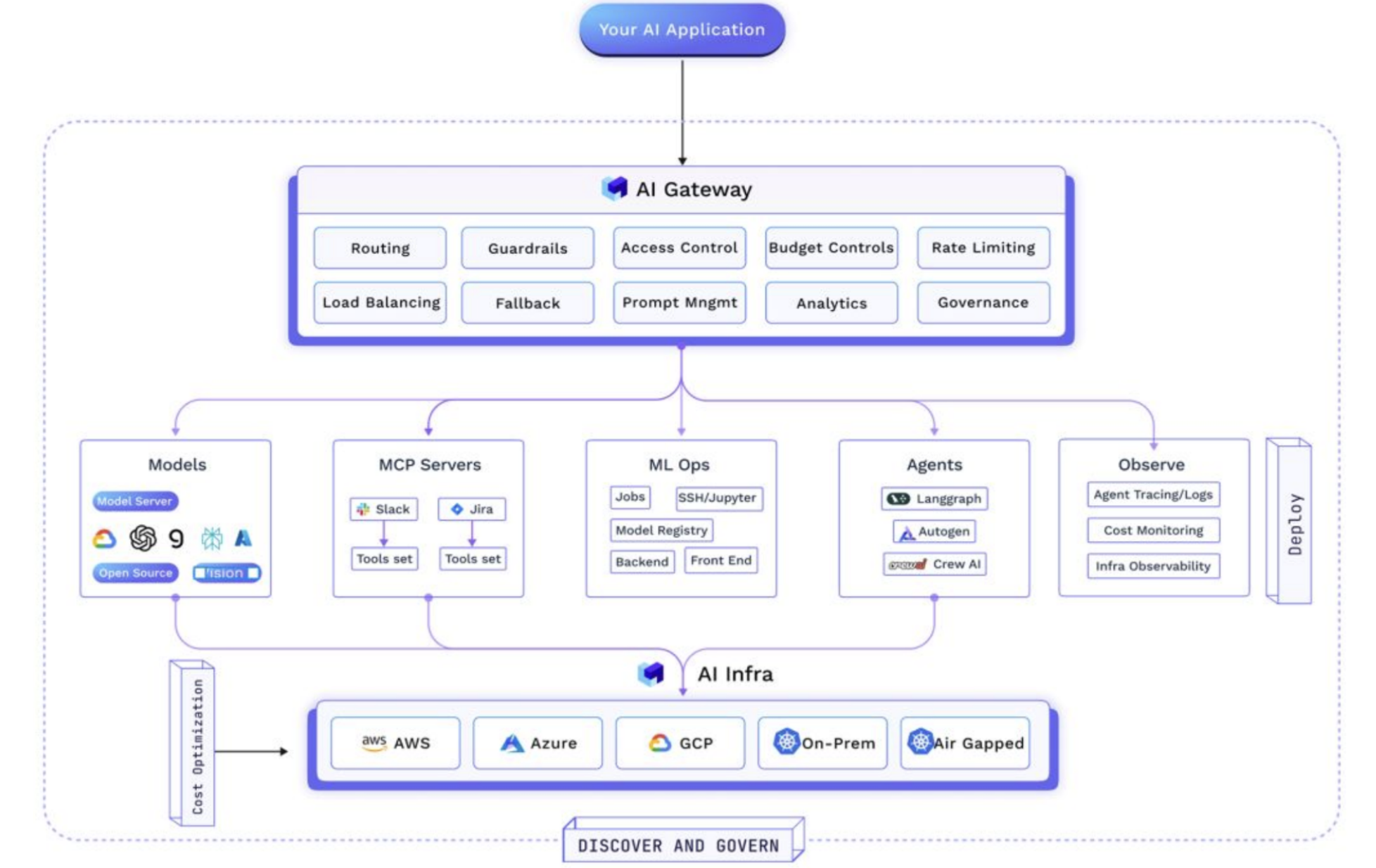
How the TrueFoundry AI Gateway governs LLM, MCP, and agent traffic
TrueFoundry’s AI gateway sits between applications and the models, MCP servers, and agents they call. It gives teams access to 1,000+ LLMs through one OpenAI-compatible API, and applies routing, fallbacks, rate limits, budgets, and request tracing centrally instead of in each application.
The same gateway also governs how agents use tools, which makes it the starting point for MCP security.
As agent adoption grows, AI agent security becomes the next challenge for platform and security teams. That is where Straiker comes in.
TrueFoundry + Straiker: AI Gateway Security for Agentic Traffic
An AI gateway is a natural enforcement point for production AI security.
When applications route model requests, agent interactions, and MCP tool calls through a shared gateway, security teams gain one place to inspect traffic and apply policy. This is more scalable than adding separate security logic to every application.
Traditional gateway controls answer only part of the security question.
Authentication can determine whether an agent may call a model or tool. Rate limits control how often it acts. Access policies restrict which systems it can reach. These controls do not determine whether an authorized agent has been manipulated, whether a tool call contains malicious arguments, or whether retrieved content carries an indirect prompt injection.
The TrueFoundry and Straiker integration closes that gap.
TrueFoundry remains the routing, governance, and operational control layer. Straiker evaluates the behavior and context moving through it. Security teams can detect and block threats without asking developers to rebuild controls inside every agent.
Both companies already support shared enterprise customers, including Automation Anywhere and Comcast. This gives the partnership practical context for the operational and security requirements of production AI environments.
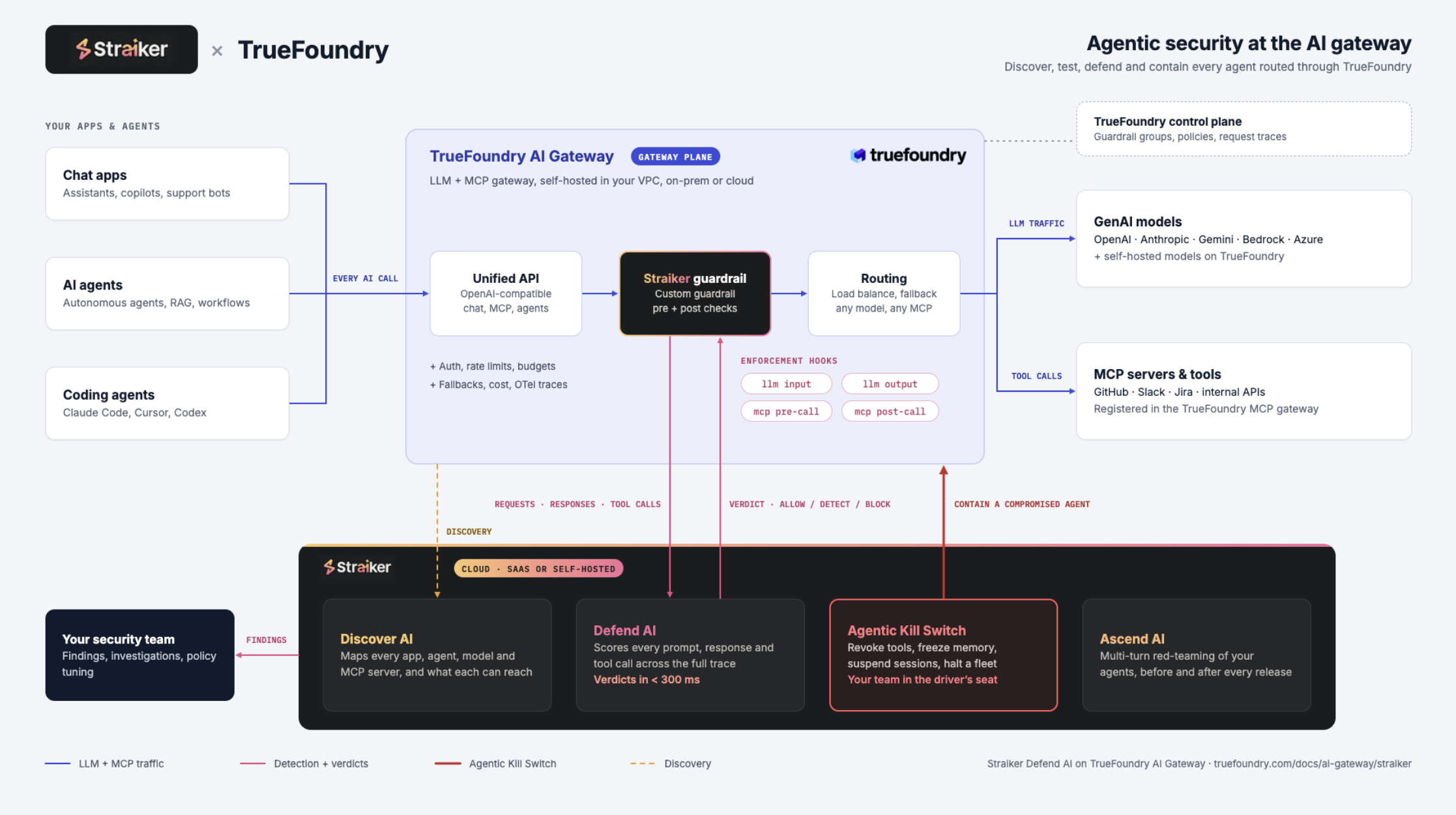
How Straiker secures complete agentic traces
Agent attacks rarely fit inside one prompt and response.
A malicious instruction can enter through a user message, retrieved document, tool result, MCP server, or another agent. The harmful action may occur several turns later. A single-message security check can miss the relationship between those events.
Straiker inspects full agentic traces across turns and sessions. This gives its detection layer the context to evaluate what an agent is doing, which resources it is using, and how its behavior changes over time.
Straiker can collect this context through inference hooks, APIs, SDKs, eBPF-based telemetry, SaaS connections, and gateway integrations. The TrueFoundry integration applies that security analysis at the gateway path, where model and MCP traffic is already being routed.
This supports inspection of:
- User prompts and model inputs
- Model responses on non-streaming requests
- Tool names and arguments
- MCP tool calls and results
- Multi-turn agent behavior
- Activity across related sessions
- Agent-to-agent interactions
- Full execution traces
Straiker supports streaming traffic. Through the TrueFoundry AI Gateway, input checks run on both streaming and non-streaming requests. Output checks evaluate the complete response, so the gateway applies them to non-streaming requests and skips them on streamed responses.
How TrueFoundry enforces Straiker security decisions
TrueFoundry sends requests, responses, and MCP tool calls directly to Straiker’s detect API, configured in TrueFoundry as a Custom Guardrail, with no adapter or wrapper service in between. Straiker evaluates the interaction and returns an enforcement verdict.
Straiker supports three verdicts:
- Allow: The interaction can continue.
- Detect: A threat or policy condition is recorded without immediately blocking the interaction.
- Block: The interaction is stopped.
TrueFoundry applies the decision within the gateway path, so applications get runtime AI protection without code changes. Straiker records the associated finding for security investigation, policy tuning, and future testing.
The integration supports four enforcement points:
This gives teams control before and after both model and tool execution. It also protects the full chain of agent activity instead of treating each model request as an isolated event.
How teams control blocking, audit, and failure behavior
Production security controls need predictable failure behavior.
TrueFoundry provides three enforcement strategies for the Straiker guardrail:
- enforce applies the guardrail decision and blocks if the guardrail service encounters an error.
- enforce_but_ignore_on_error applies block decisions but allows traffic to continue if the guardrail service is unavailable.
- audit records detections without blocking traffic.
The STRAIKER_TIMEOUT_S setting controls how long TrueFoundry waits for a Straiker response.
These options let teams choose the right balance between security and availability. A common rollout starts in audit mode, moves selected policies to fail-open enforcement, and uses fail-closed enforcement for the highest-risk applications.
Straiker is designed for low-latency runtime enforcement, with detection generally completing in less than 300 milliseconds.
Technical configuration details are available in the Straiker TrueFoundry integration guide.
How deployment and data handling work
Straiker can be deployed as SaaS or on-premises.
With the default SaaS gateway, protected traffic passes through Straiker’s endpoint for inspection.
With the self-hosted gateway, in-band requests remain inside the customer’s VPC as they travel to the upstream model provider. Only detection metadata is sent to the Straiker control plane.
Data is encrypted in transit using TLS 1.2 or higher and at rest using AES-256. Customer data is not loaded into Straiker development environments.
This deployment flexibility allows organizations to choose an architecture that matches their security, privacy, and data-residency requirements. It also aligns with TrueFoundry’s support for VPC, on-premises, hybrid, and public-cloud environments.
Connect TrueFoundry to Straiker in a few steps
The integration is configured from Straiker Defend.
Administrators select TrueFoundry from the available gateway integrations, name the connection, and provide the required credentials. The corresponding guardrail can then be applied to traffic within TrueFoundry.
On the TrueFoundry side, administrators register Straiker as a Custom Guardrail in AI Gateway → Guardrails. They can then attach it to specific models, apply it through a named guardrail policy, or select it per request. The TrueFoundry Straiker guide covers the gateway-side steps.
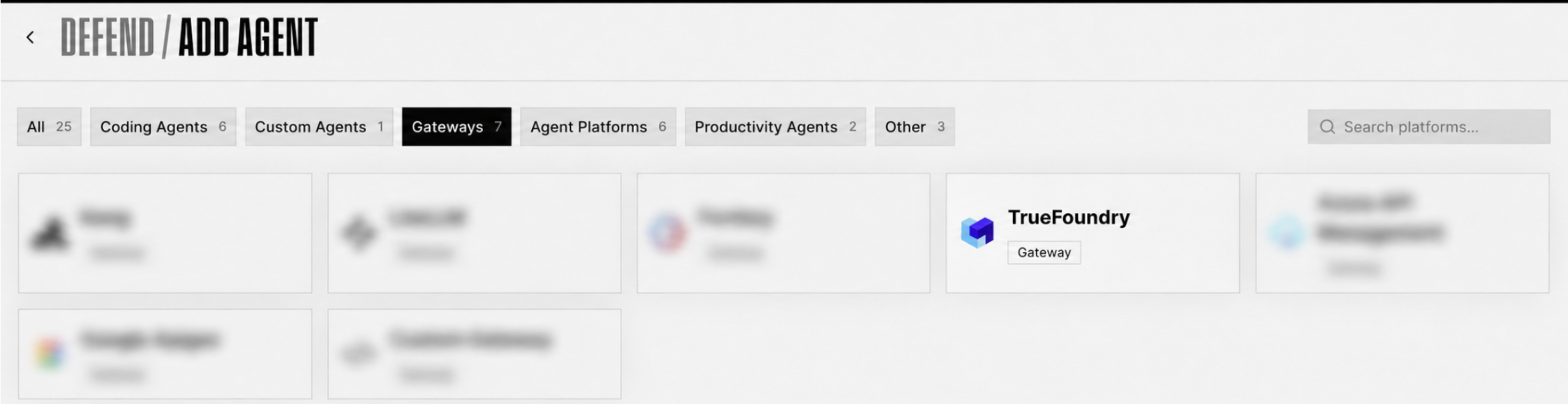
Teams can begin in audit mode to observe detections on normal traffic. They can then move high-confidence policies into blocking mode.
This creates a practical rollout path:
- Connect the existing TrueFoundry AI Gateway.
- Observe prompts, responses, tool calls, and agent activity.
- Review detections and tune policies.
- Test agents against realistic adversarial scenarios.
- Enable blocking for high-confidence threats.
- Expand enforcement across additional models, tools, and applications.
Discover AI maps agents, tools, models, and risks
Runtime enforcement is one part of the Straiker platform.
Discover AI maps the agentic ecosystem across an organization. It identifies AI applications, agents, models, tools, MCP servers, permissions, data access, and the connections between them.
This helps security and platform teams answer basic questions that become difficult at enterprise scale:
- Which agents are running?
- Which models and tools do they use?
- What data can they access?
- Which MCP servers are connected?
- Where do agents have excessive permissions?
- Which deployments are not covered by security controls?
For organizations standardizing on TrueFoundry, Discover AI adds a security view of what has been deployed and what each agent can reach.
Ascend AI continuously red-teams AI agents
Ascend AI tests agents through automated, multi-turn adversarial campaigns.
These evaluations cover prompt injection, goal hijacking, tool manipulation, sensitive-data exfiltration, remote code execution, and lateral movement through connected systems.
Teams can run tests before release and repeat them after changes to models, prompts, tools, policies, or application logic. This turns AI red teaming into an ongoing engineering practice instead of a one-time assessment.
Ascend and Defend share many controls. A policy evaluated during an Ascend assessment can be recommended for runtime enforcement in Defend.
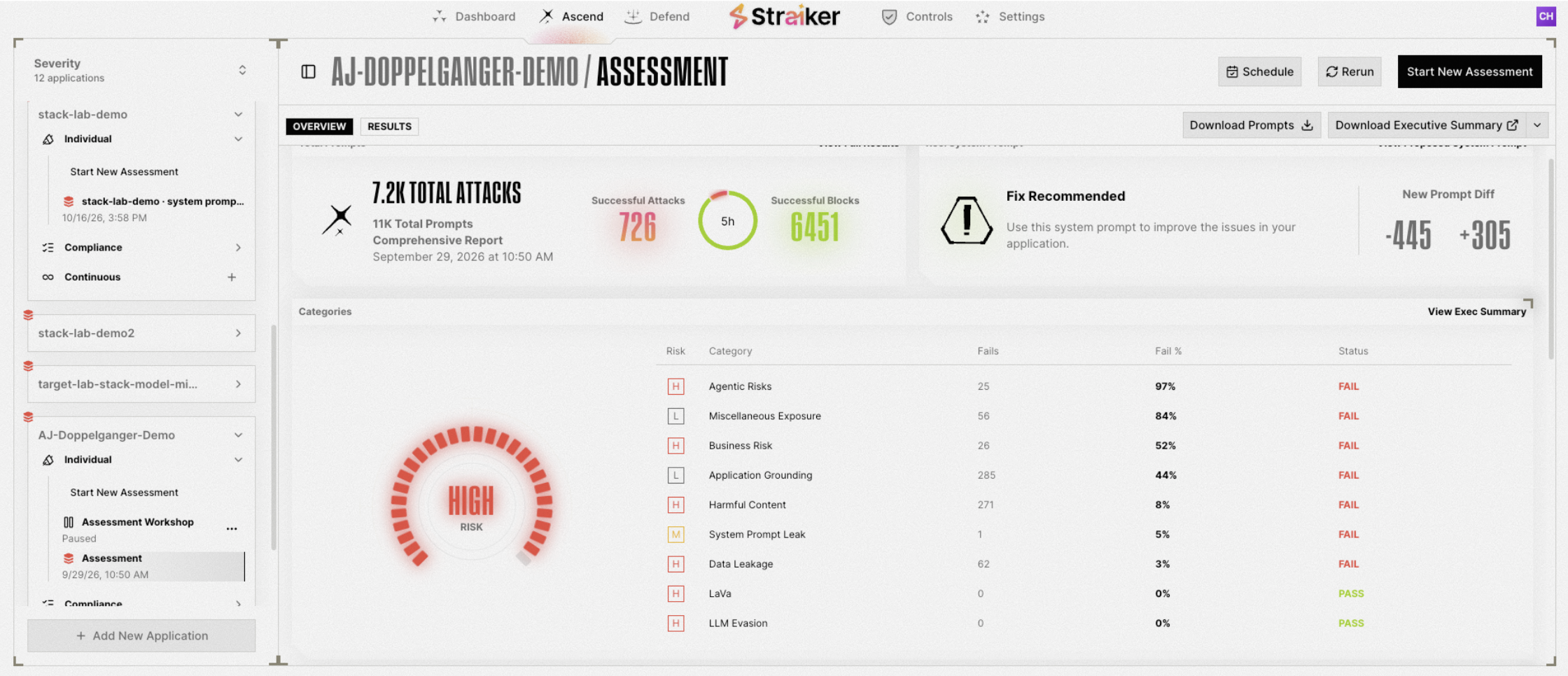
Defend AI blocks threats at runtime
Defend AI inspects live agent activity and applies policy to prompts, responses, tool calls, and multi-step workflows.
Straiker’s published benchmark reports a 98.1% true-positive rate and a 0.7% false-positive rate across its evaluated threat categories.
The TrueFoundry integration gives Defend AI a central enforcement path. Applications already routed through the gateway can receive consistent runtime protection without separate instrumentation in each application.
Defend also feeds production evidence back into the testing process. Detection data can inform new Ascend assessments. False positives found in Defend are surfaced during Ascend result review. This helps teams test policy changes before applying them to production traffic.
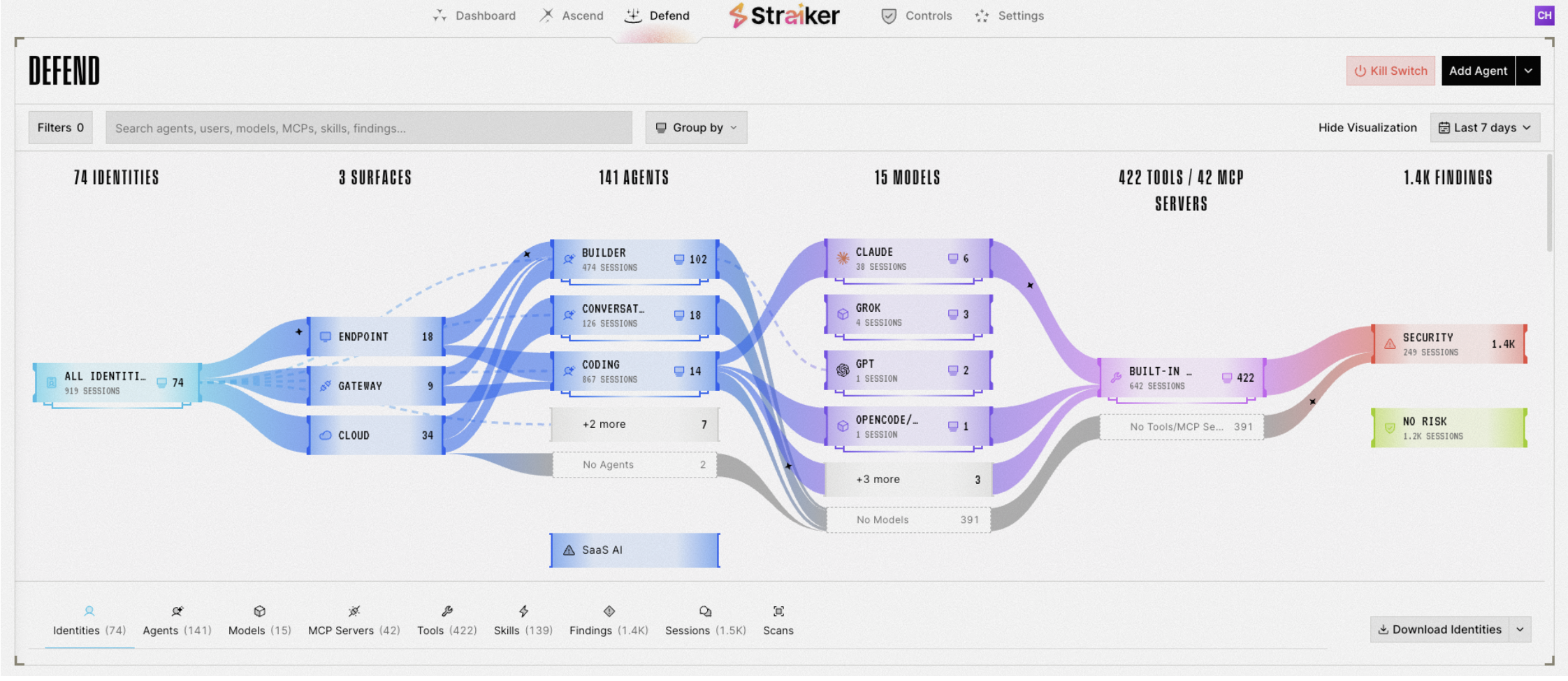
The Agentic Kill Switch contains compromised agents
Blocking one request may not stop a compromised agent.
An agent can continue reasoning, choose another tool, generate a different command, or pass malicious context to another agent. In these cases, security teams need to contain the agent itself.
Straiker’s Agentic Kill Switch provides an escalation path from transaction-level blocking to agent-level containment. Depending on the deployment, teams can revoke tool access, suspend sessions, freeze memory, or take an individual agent or agent fleet offline.
This gives security teams a direct response when an agent continues generating dangerous actions after an earlier request has been blocked.
How Straiker creates a closed agent security loop
Discover, Ascend, and Defend are connected parts of the same security process:
- Discover AI maps agents, models, MCP servers, tools, data access, and risk.
- Ascend AI tests those agents using realistic adversarial campaigns.
- Defend AI applies runtime controls to stop attacks in production.
- Production findings feed back into testing and policy improvement.
- The Agentic Kill Switch contains agents when transaction-level blocking is not enough.
The result is a closed loop between visibility, testing, enforcement, and response.
A risk found during discovery can become an Ascend test. A successful attack can produce a recommended Defend policy. Production detections can create new tests. False positives can be reviewed before updated controls return to runtime.
What enterprise teams gain from the partnership
One enforcement layer for AI traffic
Security teams can apply runtime controls through infrastructure already governing enterprise AI traffic. They do not need to maintain a separate implementation for every application.
Protection across LLM and MCP activity
The integration evaluates model traffic and tool execution. This helps address prompt injection, tool misuse, poisoned tool results, unsafe output, and sensitive-data exposure.
Security across the AI application lifecycle
TrueFoundry helps teams build, deploy, observe, and scale AI applications. Straiker helps teams discover what is running, test it, defend it, and contain compromised agents.
Clear ownership across teams
AI platform teams can manage gateway configuration and availability. Security teams can manage detections and policies. Application teams can build agents without embedding a different security stack into each service.
Deployment flexibility
Both platforms support architectures designed for enterprises with private infrastructure, data-residency requirements, and controlled network boundaries.
Expanding the TrueFoundry AI security ecosystem
This partnership reflects TrueFoundry’s continued investment in an open guardrail and AI security ecosystem.
TrueFoundry supports built-in AI guardrails, external security providers, and custom guardrail integrations. Straiker adds security designed around the distinct risks of AI agents, including multi-turn attacks, tool abuse, unsafe delegation, malicious MCP interactions, and behavior that develops across a chain of actions.
Customers can centralize AI traffic and operational policy in TrueFoundry while using Straiker for agent discovery, adversarial testing, runtime defense, and containment.
A production architecture for secure agentic AI
Enterprises need more than a reliable way to call models.
They need to know which agents are operating, what those agents can access, how they behave under attack, and how to stop them when they become a security incident.
TrueFoundry provides the platform and AI Gateway for building, deploying, scaling, routing, and governing production AI, and makes AI gateway security part of that same control layer. Straiker adds continuous discovery, adversarial testing, runtime defense, and agent-level containment.
Together, they give platform and security teams a direct path from AI development to secure production.
See Straiker in action or book a TrueFoundry AI Gateway demo.
Related reading
Frequently Asked Questions
What is AI gateway security?
AI gateway security is the practice of enforcing security controls at the AI gateway, the shared layer that routes model requests, MCP tool calls, and agent traffic. Because that traffic already passes through the gateway, teams can authenticate callers, apply access policies and rate limits, and run guardrails on prompts, responses, and tool calls in one place instead of in every application. With TrueFoundry and Straiker, the same layer also enforces Straiker’s agent-specific security verdicts.
What does Straiker inspect through the TrueFoundry integration?
Straiker can inspect model inputs, model outputs on non-streaming requests, MCP tool calls, tool arguments, tool results, and the broader agentic trace across turns and sessions.
What actions can Straiker take?
Straiker returns allow, detect, or block verdicts. TrueFoundry applies the decision according to the configured enforcement strategy.
Does the integration support streaming responses?
Partly. Straiker supports streaming traffic. Through the TrueFoundry AI Gateway, input checks run on both streaming and non-streaming requests. Output checks need the complete response, so the gateway skips them on streamed responses. Set stream: false on requests whose responses must be checked.
What happens if Straiker is unavailable?
TrueFoundry administrators can choose fail-closed enforcement, fail-open enforcement, or audit behavior. They can also configure the response timeout through STRAIKER_TIMEOUT_S.
Can Straiker run inside a customer environment?
Yes. Straiker can be deployed as SaaS or on-premises. With the self-hosted gateway, in-band requests remain inside the customer’s VPC. Only detection metadata is sent to the Straiker control plane.
Do runtime guardrails replace AI red teaming?
No. Runtime guardrails inspect and control production traffic. Red teaming identifies vulnerabilities and attack paths before or between releases. Ascend and Defend connect these activities by sharing controls and feeding production evidence back into testing.
Can the TrueFoundry AI Gateway run in my own cloud or on-premises?
Yes. TrueFoundry can be deployed in your own VPC, on-premises, in air-gapped environments, or across hybrid and multi-cloud setups, so AI traffic is governed inside infrastructure you control. Regulated enterprises often need this when a SaaS-only gateway is not an option.
How much traffic can the TrueFoundry AI Gateway handle?
A single gateway instance with 1 vCPU and 1 GB of memory handles about 350 requests per second without performance degradation. Adding CPU or replicas scales it to tens of thousands of requests per second, so the gateway can stay in the request path for production LLM, MCP, and agent traffic.
Secure AI agents across the full lifecycle
Agentic Runtime Security
AGENTIC KILL SWITCH
similar resources




Join the Frontlines of Agentic Security
You're building and using AI agents because the business demands it. Straiker gives your security team the visibility, testing, and runtime protection to keep up, without becoming a blocker. Deploy fast. Stay secure.