

Purpose-built for agentic AI security
Frontier models weren't designed for runtime AI security detection. Straiker was. See the benchmarks.
.svg)
True positive rate
.svg)
False positive rate

Median detection latency
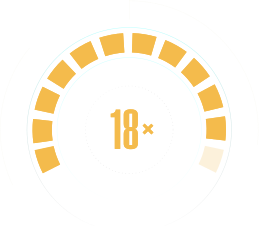
Faster than GPT-5.4

/ the case for purpose-built security /
Why runtime AI security requires more than frontier models
General-purpose LLMs are trained to be helpful, not to be security enforcement layers. There are three fundamental gaps that make them unsuitable as your primary AI threat detection engine.
Latency kills runtime protection
Runtime AI security requires sub-100ms decisions. Frontier models return responses in 600–900ms. At that speed, a prompt-injection attack has already reached your agent before the flag fires.
Helpfulness vs. security precision
Frontier models are fine-tuned to complete requests. Straiker is fine-tuned to detect threats. That's a fundamentally different optimization objective and it shows in the false-positive rates.
Single models are single points of failure
A single-model architecture can be probed, jailbroken, or manipulated. Straiker's Medley of Experts architecture routes signals across multiple specialized models, making it significantly harder to defeat.
/ model comparison /
Straiker vs Claude, ChatGPT & Gemini for AI security detection
General-purpose LLMs are trained to be helpful, not to be security enforcement layers. There are three fundamental gaps that make them unsuitable as your primary AI threat detection engine.
/ accuracy benchmark results /
Attack coverage across every threat category and harm type
Detection coverage mapped across 13 attack techniques and 13 harm categories. Green = blocked. Red = missed.

/ live comparison/
Feel the latency difference
Select a real attack from our test corpus. Watch Straiker respond before competing models have even started inferencing.
/ benchmark methodology /
How these benchmarks were produced
Straiker uses a fundamentally different architecture than any of the models it's compared against. Understanding that is key to interpreting these results.
Medley of Experts architecture
Straiker does not use a single frontier LLM as its detection engine. Instead, it runs a Medley of Experts — a set of purpose-trained, specialized models that are each optimized for a specific detection task:
PII Exfiltration
Models fine-tuned on large labeled corpora of real AI agent threats, maximizing true positive rate per category.
Latency experts
Models fine-tuned on large labeled corpora of real AI agent threats, maximizing true positive rate per category.
Security-specific experts
Models trained exclusively on security signals: prompt injection, PII exfiltration, jailbreaks, policy violations, and more.
Test corpus & evaluation protocol
Straiker does not use a single frontier LLM as its detection engine. Instead, it runs a Medley of Experts — a set of purpose-trained, specialized models that are each optimized for a specific detection task:
Labeled malicious samples
TPR is measured against samples verified as genuine threats by human security analysts — not generated examples.
Labeled benign production traffic
FPR is measured on real traffic samples drawn from production workloads, ensuring false positive rates reflect deployment reality.
Latency measurement
Median wall-clock time from request submission to first classification decision, measured over 1,000 runs per model via public APIs at default settings.
Important clarification
Straiker's Medley of Experts architecture does not use Claude, GPT-5.4, or Gemini as detection components. The models compared in these benchmarks are the same models being used as standalone detection layers, which is a real deployment pattern Straiker customers adopt before switching to Straiker. We are not comparing against ourselves. We are showing what happens when you try to use a general-purpose LLM as a security detection engine versus using something purpose-built for that role.
Additional resources
no resources found
Secure the agentic era of AI
See Straiker's detection engine in action against your real prompts and agent workflows.