Healthcare AI Agent Discovery: Why Inventory Comes Before Governance
Because 37% of healthcare groups uncover shadow AI, discovery reveals inherited access, tools, and PHI exposure before attempting governance or enforcement.

Healthcare organizations need, AI agent discovery because their agentic estates extend far beyond approved applications. Coding agents, productivity copilots, low-code builders, cloud platforms, MCP servers, Agent Skills, and homegrown systems can all inherit access to sensitive data and tools. A live inventory helps security teams identify systems operating outside traditional approval and procurement processes.
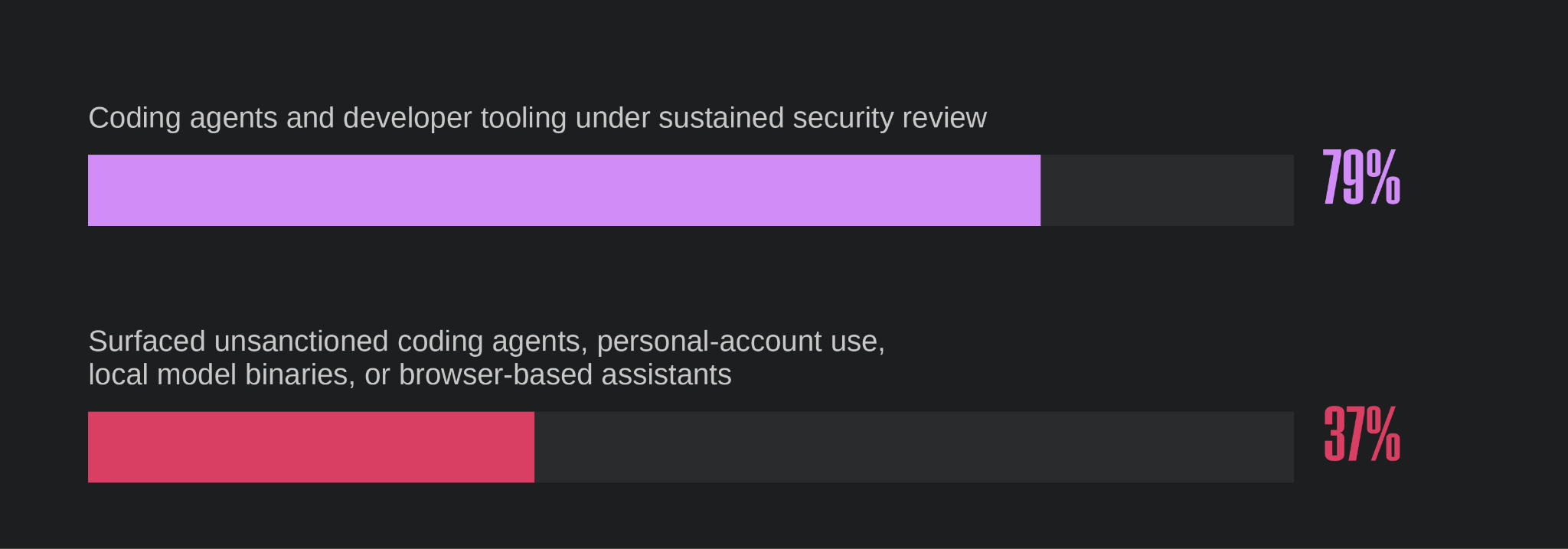
That gap is becoming difficult to ignore. Straiker’s analysis of healthcare and health-tech deployment, assessment, and technical evaluation records found that 79% of organizations had coding agents and developer tooling under sustained security review. Yet 37% surfaced some combination of unsanctioned coding agents, personal-account use, local model binaries, or browser-based assistants.
Healthcare AI security therefore depends on a continuously updated view of the agentic estate that includes both approved and unapproved tools.
The findings come from deployment, assessment, and technical evaluation records rather than survey responses. The dataset is current through September 2026, and a finding is reported only when at least three unrelated organizations support it.
Healthcare agent stacks are fragmented by design
Healthcare organizations rarely have one team making every AI decision. Clinical, claims, pharmacy, research, analytics, digital-product, operations, and corporate groups may each adopt different tools. Developers use coding agents locally. Business teams create workflows with low-code builders. Employees connect productivity agents to mailboxes, file stores, tickets, calendars, and internal knowledge bases.
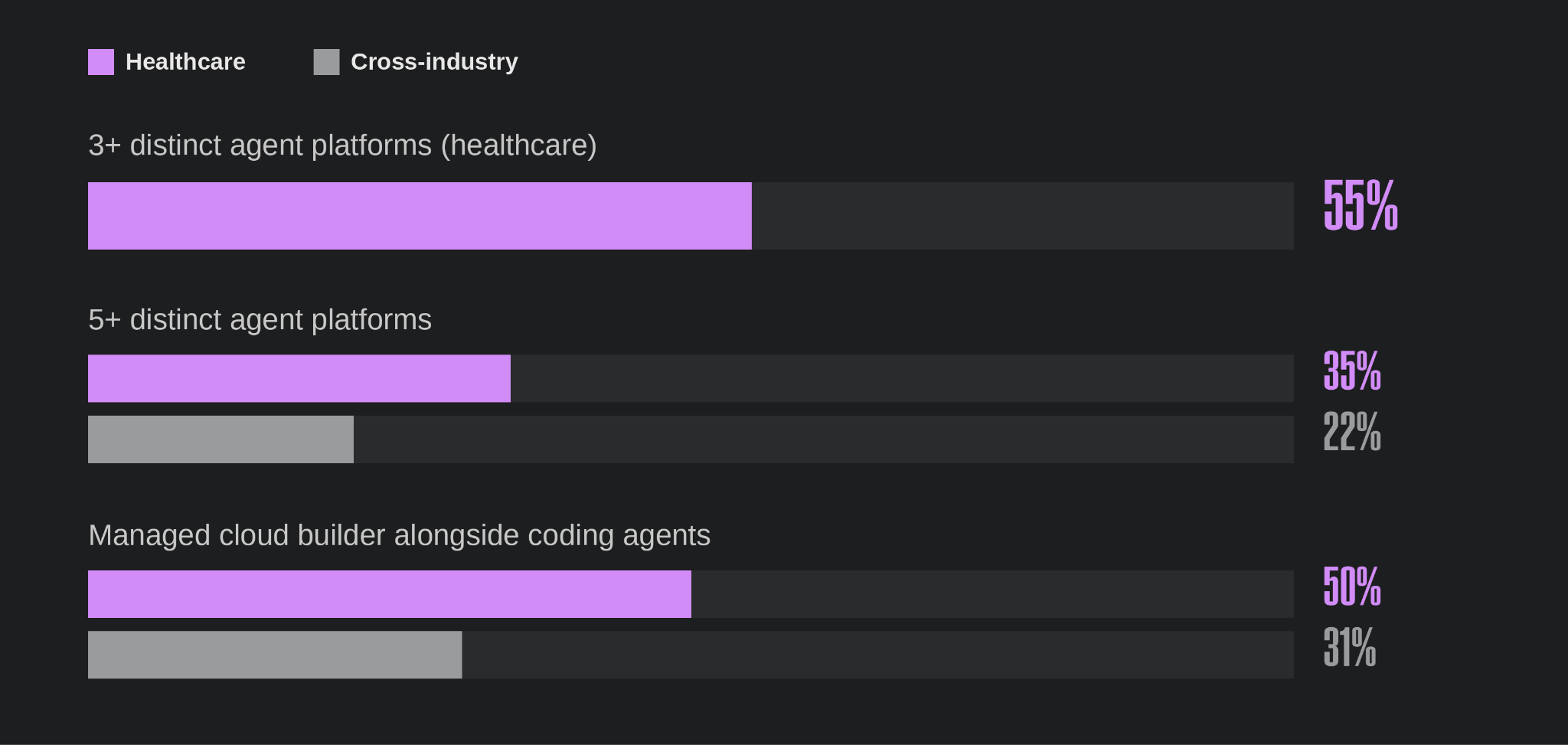
These parallel adoption paths create more fragmentation than many security teams expect. In Straiker’s healthcare cohort, 55% of organizations had three or more distinct agent platforms, while 35% had five or more. The five-platform figure was 22% in the broader cross-industry comparison population. Half of healthcare organizations also operated a managed cloud builder alongside coding agents, compared with 31% across industries.
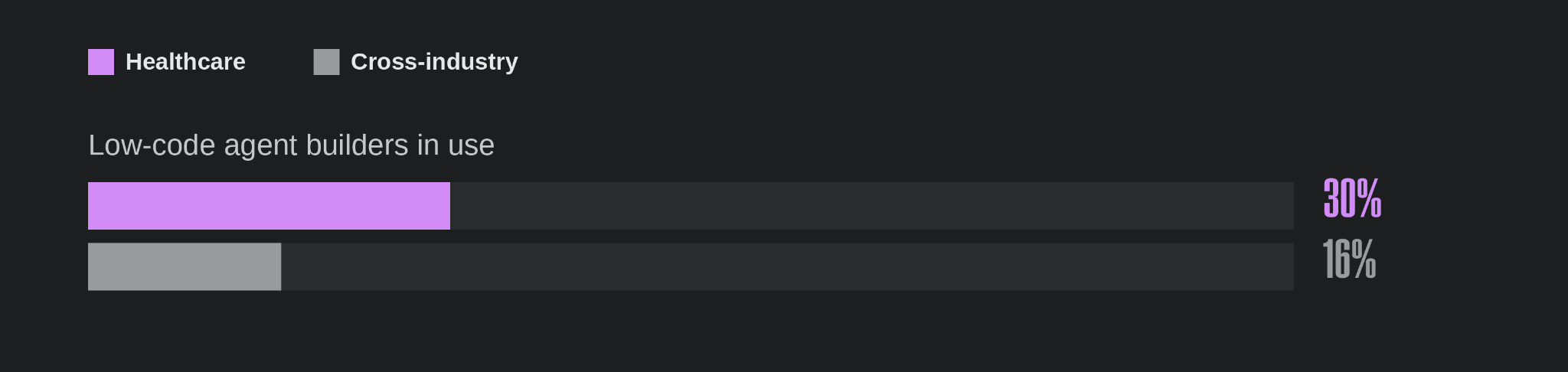
Low-code agent builders appeared in 30% of the healthcare cohort, almost twice the 16% cross-industry rate. These tools can help benefits, care coordination, revenue cycle, and member-services teams build useful workflows close to sensitive data. They can also place agentic systems outside the engineering and application-security reviews used for conventional software.
Because these systems span teams, platforms, and execution paths, no single gateway, console, or procurement record can represent the entire environment.
What should healthcare AI agent discovery reveal?
Effective AI agent discovery should answer five questions:
1. Which AI agents are operating across the organization?
Discovery should cover agents running through cloud platforms, enterprise copilots, developer machines, browsers, low-code tools, and internally built applications. It should account for approved deployments as well as unsanctioned tools that may never appear in a central application inventory.
2. Who owns each AI agent?
Every agent should have an identifiable business owner and technical owner. Clear ownership helps security teams determine who can approve changes, investigate unexpected behavior, and take action when an agent creates risk.
3. Which identities and permissions does each agent inherit?
An agent may act through a user's identity, a service account, or a workload identity. Discovery should map these identities to their permissions, credentials, and effective authority so teams can understand what an agent could access or change.
4. What data, tools, and systems can each agent reach?
Security teams need visibility into the models, tools, MCP servers, Agent Skills, data sources, and downstream systems connected to each agent. In healthcare, this includes access paths involving PHI, claims records, member information, clinical systems, source code, and infrastructure.
The important question is how these connections combine. An agent with access to several individually approved resources may still create a significant risk if those connections allow it to move sensitive information or perform actions beyond its intended role.
5. Where can security teams observe or stop an agent's actions?
Discovery should identify where an agent executes and which security controls can observe its behavior. A gateway can inspect only the traffic that passes through it, while a control tied to a managed cloud platform covers agents operating within that platform. Out-of-band monitoring may detect an action after it occurs, whereas an inline control may be able to block it before it reaches a production system.
Together, these details form an agentic estate map. Unlike a conventional software inventory, this map documents how each agent's identity, authority, context, tools, connections, and data access relate to one another. That context helps security teams identify risky access paths and prioritize the agents that warrant closer scrutiny.
How AI agent discovery supports healthcare AI governance
AI agent discovery supplies the inventory, ownership, access, and connection data that AI agent governance requires. Security teams also need evidence that agents can be tested, monitored, and contained when their behavior creates risk.
Gateway policies apply only to traffic that crosses the gateway. Controls attached to a managed cloud platform apply only to agents operating through that platform. An out-of-band control can report an action after it occurs, while an inline control may be able to stop the action before it reaches a production system.
Straiker’s agentic AI security platform connects these requirements through a continuous control cycle. Discover AI inventories agents and their connections. Ascend AI adversarially tests agents through the execution paths they use. Defend AI detects and blocks malicious behavior at runtime. The Agentic Kill Switch gives an authorized person a way to remove an agent’s authority when it can no longer be trusted.
Together, these capabilities support an enterprise AI agent security program that can identify high-authority coding agents today and extend the same inventory, testing, runtime, and containment requirements to patient-, member-, claims-, and clinician-facing agents as their autonomy grows.
Download the healthcare agentic AI whitepaper
The full research explains what healthcare and health-tech security teams are inventorying, testing, and enforcing across their agentic estates. It includes benchmark data, a buyer’s checklist, and a detailed map from the findings to Straiker’s discovery, adversarial testing, runtime protection, and containment capabilities. Download this whitepaper.

Frequently Asked Questions
What are shadow AI agents?
Shadow AI agents are agentic tools or workflows operating without complete security visibility or approval. They may include personal-account coding assistants, local binaries, browser assistants, unsanctioned copilots, or homegrown agents that never appear in a central procurement record or AI gateway.
Why is AI agent discovery important in healthcare?
An AI agent may inherit identities and permissions that reach PHI, claims, member, clinical, source-code, and infrastructure systems. Discovery helps security teams identify those access paths before they begin testing, policy enforcement, or incident response.
How does AI agent discovery differ from traditional asset inventory?
Traditional asset inventories typically focus on applications, devices, infrastructure, and other identifiable technology assets. AI agent discovery also maps how agents use identities, inherit permissions, connect to tools, retrieve information, and act on downstream systems.
This additional context helps security teams understand the potential consequences of an agent's access and identify risks that a list of approved applications alone may not reveal.
What should healthcare organizations look for in an AI agent security platform?
Healthcare organizations should look for continuous discovery across approved and unsanctioned environments, visibility into agent identities and permissions, and an understanding of the tools and data each agent can access. They should also evaluate whether the platform can adversarially test agents, detect and block malicious behavior at runtime, and support rapid containment when an agent becomes untrusted.
Coverage across actual execution paths is essential because a security control cannot reliably protect activity it cannot observe or intercept.
Secure AI agents across the full lifecycle
Agentic Runtime Security
AGENTIC KILL SWITCH
similar resources




Join the Frontlines of Agentic Security
You're building and using AI agents because the business demands it. Straiker gives your security team the visibility, testing, and runtime protection to keep up, without becoming a blocker. Deploy fast. Stay secure.