Agentic Security vs Agentic AI for Cybersecurity
Agentic AI performs security work across the SOC, AppSec, cloud, identity, and more, while agentic security protects enterprise AI agents.

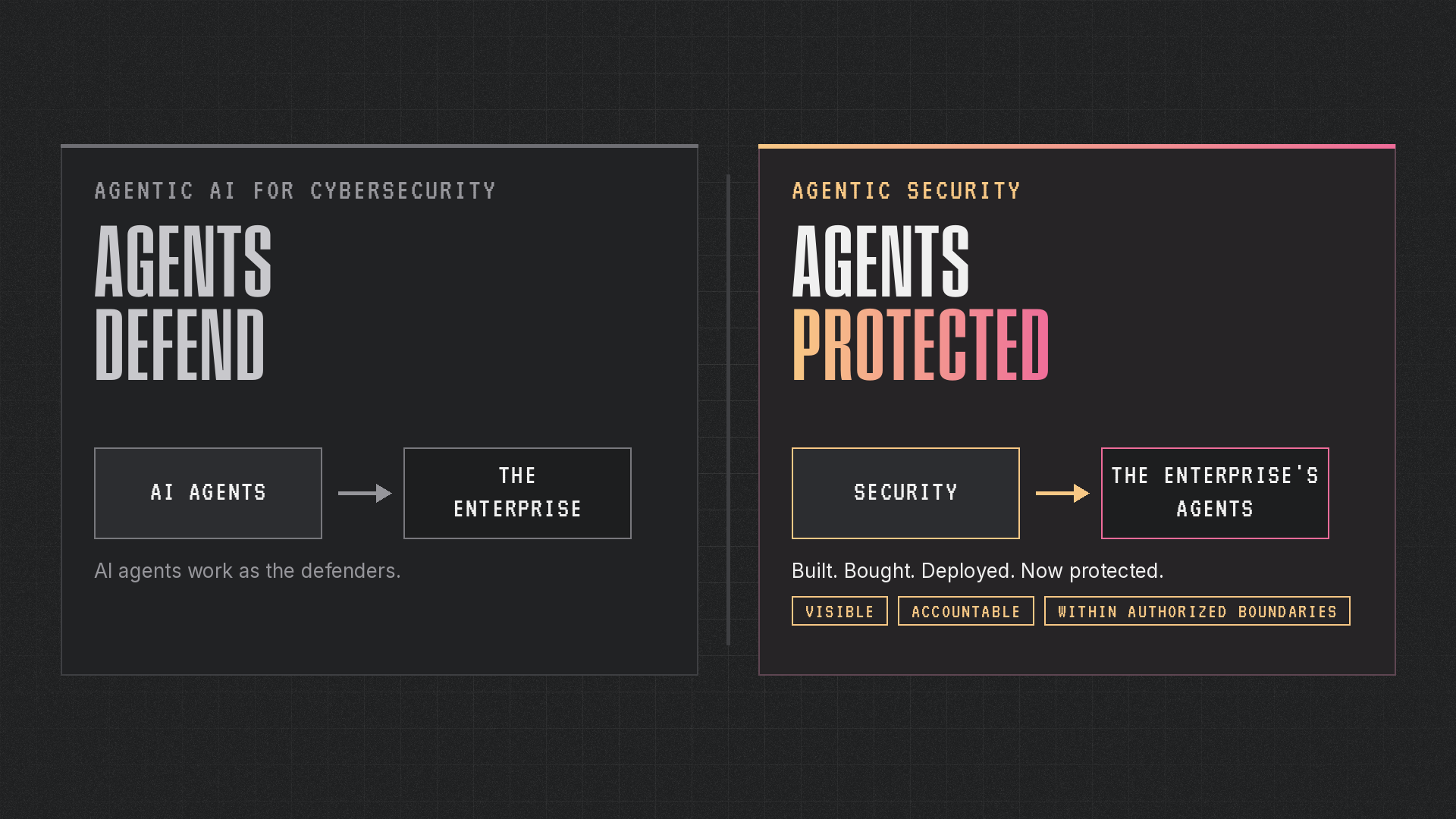
The short answer: Agentic AI for cybersecurity puts AI agents to work defending the enterprise, while agentic security protects the agents the enterprise builds, buys, and deploys so they remain visible, accountable, and within authorized boundaries.
The easiest way to keep the categories straight is to ask what job the agent is doing: is the agent performing security work, or is security controlling an agent while it performs business work?
The Difference Between Agentic Security and Agentic AI for Cybersecurity
The market language is still evolving. In this article, agentic AI for cybersecurity means AI agents performing security work, while agentic security means securing agents and the systems around them. The categories are adjacent rather than mutually exclusive, because a vendor can use agents inside a security product while also providing controls that protect other agents.
Gartner research treats these as distinct concerns. Its AI SOC agents research covers agents that augment common security operations tasks, while its research on agentic security and its AI application security market focus on protecting AI agents and applications through identity, discovery, testing, governance, and runtime defense.
An AI agent can make SOC investigations, code review, vulnerability analysis, or cloud defense faster, but it does not automatically discover or control the coding, productivity, customer-facing, or custom agents used elsewhere in the business.
Agentic AI for Cybersecurity Use Cases Go Beyond the SOC
Agentic AI for cybersecurity uses autonomous or semi-autonomous agents to perform security work across the SOC, application security, vulnerability and exposure management, identity, cloud security, threat intelligence, and offensive testing. The category is defined by the agent's job, not by where the product sits in the organization. Microsoft describes security agents that analyze data, investigate anomalies, and orchestrate security workflows. A familiar example is an alert-triage agent that enriches an alert with asset, identity, and threat context before recommending the next action.
The SOC is the most visible starting point, with agents triaging alerts, gathering evidence, correlating signals, hunting for related threats, and triggering approved response playbooks while people retain approval when an action could disable a business system, change access, delete data, or create regulatory consequences.
Application security is another strong example. An agent can review a pull request for exploitable bugs, trace a finding through related code, attempt to reproduce it, propose a patch, and rerun security tests to determine whether the fix holds, while a qualified person approves the change before it is merged. The agent is performing cybersecurity work even though it operates inside a developer workflow rather than the SOC.
Agentic SOC products such as 7AI and Prophet Security investigate alerts and support response, while agentic AppSec tools such as Agentic StackHawk help coding agents run dynamic tests, interpret findings, fix vulnerabilities, and verify the result. These are two use cases within a broader category that also includes exposure management, identity, cloud defense, threat intelligence, and offensive testing.
For leadership, the practical question is whether a security agent improves the work it was assigned without introducing unclear accountability or allowing high-impact actions to occur without appropriate human review. Measures should follow the use case: SOC leaders can track investigation and response time, application security leaders can track validated findings and remediation time, and exposure teams can track whether prioritized attack paths are confirmed and closed.
Agentic Security Protects the Agents Your Business Deploys
Agentic security discovers, assesses, controls, and defends AI agents across their lifecycle. Its purpose is to ensure agents can access only the data and tools they need, take only authorized actions, and be observed and stopped when behavior becomes unsafe.
An agent can plan, remember, use credentials, call tools, communicate with other agents, and change external systems, so the failure mode is no longer limited to a bad answer because an autonomous agent can also take a bad action through tool manipulation, agent hijacking, or agentic misalignment.
Joint government guidance on the careful adoption of agentic AI recommends that organizations never give agents broad or unrestricted access, especially to sensitive data or critical systems. NIST's 2026 analysis found broad agreement that agents create novel threats and that established cybersecurity practices must adapt.
Why Prompt Guardrails Are Not Runtime Controls
Prompt guardrails tell an agent how it should behave, while runtime controls observe what the agent actually tries to do and allow, block, or require approval when an action occurs. Instructions such as do not disclose confidential data can reduce accidental drift, but they do not create a reliable security boundary because agents also process untrusted language from email, webpages, code repositories, tool descriptions, agent memory, and other agents. Attackers can use indirect prompt injection to redirect an agent while it operates with a legitimate user's access, which means the agent may appear authorized even while its behavior has moved outside the user's intent.
Effective agentic security places enforceable controls outside the agent's reasoning loop. AWS recommends deterministic external controls for tool access, operations, and data reach, so a manipulated, misconfigured, or misdirected agent cannot rely on its own reasoning to decide whether it crossed a boundary.
The Controls Enterprise AI Agents Need
TL;DR: discover every agent, give it a distinct identity and the minimum access required, test realistic workflows before deployment, monitor its tool calls and data movement, require approval for consequential actions, and preserve a reliable way to stop it.
- Visibility: Discover agents, identities, models, skills, tools, data connections, and agent-to-agent relationships.
- Least privilege: Give every agent a distinct identity and the minimum permissions required for its task.
- Predeployment testing: Use autonomous attack simulation to probe prompt injection, goal hijacking, tool misuse, data leakage, privilege abuse, and unexpected code execution.
- Runtime enforcement: Inspect actual behavior and block actions that violate policy, even when the agent believes the action supports its goal.
- Human approval: Require a person to authorize high-impact, irreversible, or ambiguous actions.
- Containment: Revoke credentials, isolate tools, pause workflows, or activate an AI agent kill switch.
- Auditability: Record decisions, tool calls, data access, policy events, and interventions for investigators and auditors.
Where Agentic Security Matters in the Business
The risk changes with the job an agent receives, because a read-only summarizer should not be governed like an agent that can run code, change a customer account, create a purchase order, or prepare a payment. The appropriate controls depend on the data the agent can reach, the tools it can invoke, how independently it can act, and the business impact of a mistake or deliberate misuse.
How to Roll Out Claude Code or Codex Safely
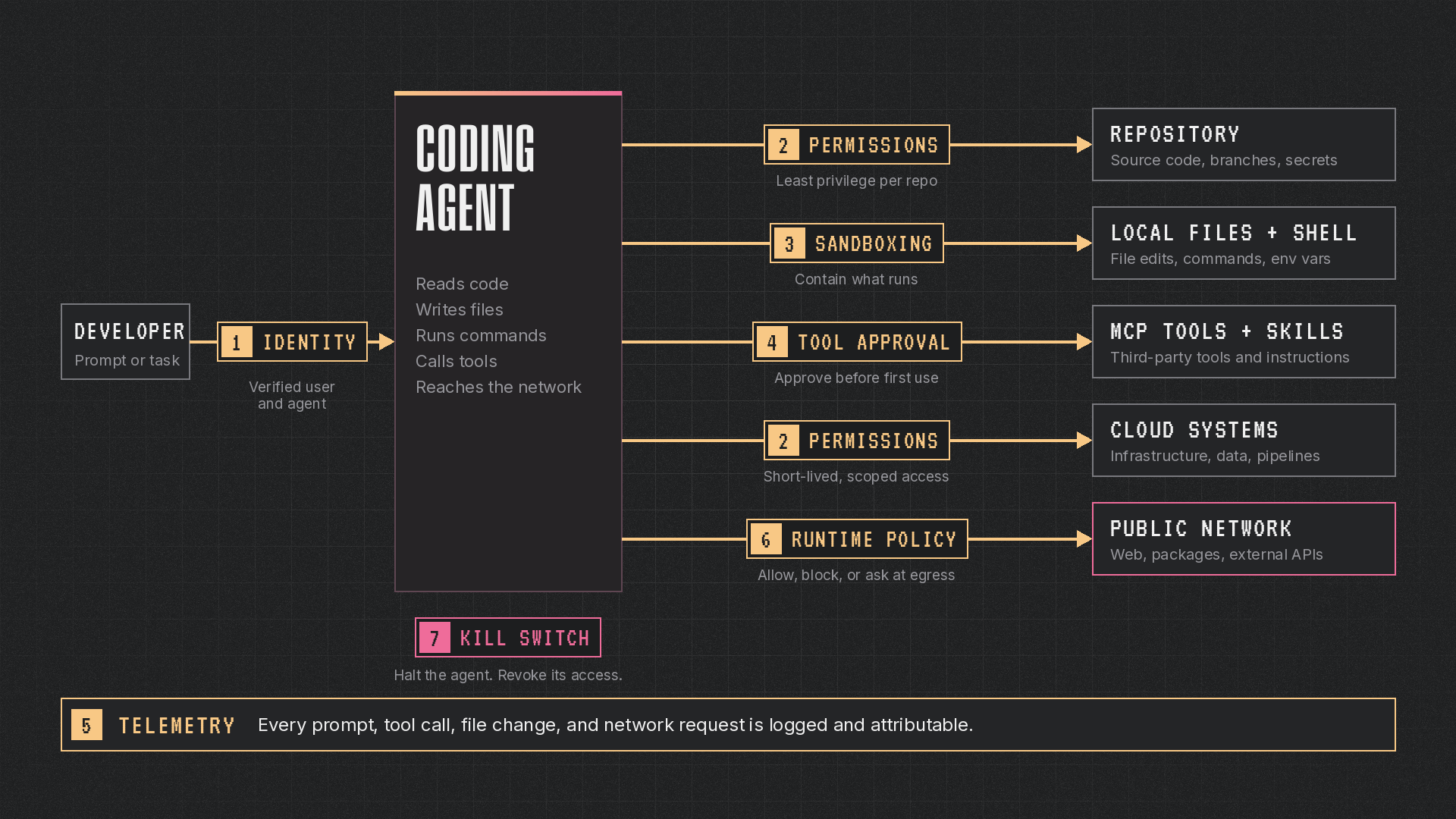
A broad rollout of Claude Code, Codex, or other coding agents can improve developer throughput, and the tools are not inherently unsafe. Risk depends on how they are configured, what they can reach, and how their work is reviewed, because a malicious insider can intentionally push an agent beyond its approved purpose, a compromised or misdirected agent can exceed its instructions even when the user began with a legitimate request, and an overly eager agent can appear to go rogue by attempting to escape its sandbox or work around a restriction it sees as blocking the task.
The productivity benefit comes from abstraction: a developer or citizen builder describes an outcome, then the agent produces code, integrations, configuration, and sometimes deployment artifacts. That same abstraction can make assurance harder when nobody reviews every generated line, the builder cannot explain how data moves through the application, or an internal prototype becomes available to external users before anyone confirms that its authentication, authorization, logging, dependency, and data-handling choices are secure enough.
In this context, Model Context Protocol (MCP) connects agents to external tools and data. Agent skills package instructions, scripts, reference material, and other resources that teach an agent how to perform repeatable work. A skill can be as consequential as an MCP connection because it may tell the agent which tools to use, in what order, and with what data, while also carrying executable code. Every approved MCP connection or loaded skill expands both business capability and potential blast radius. Security teams should inventory and inspect both before approval, monitor how agents use them, and enforce runtime controls that determine whether an agent may execute a command, reach a destination, retrieve a secret, or make a change at the moment of action.
1. Inventory and centralize identity. Require enterprise authentication, approved installations, named owners, and visibility into who uses each coding agent.
2. Define execution boundaries. Set repository, file-system, shell, network, and cloud-access policies by team and risk tier.
3. Govern MCP servers and agent skills. Allow only approved MCP servers and agent skills, inspect the instructions, scripts, code, permissions, and external destinations they introduce, and require reapproval when any of those elements change.
4. Test realistic attack paths. Seed repositories, agent skills, issues, documentation, and tool output with adversarial instructions to confirm the agent does not disclose secrets or execute unsafe commands.
5. Monitor agent-native activity. Capture prompts, skill loads, approvals, tool calls, command results, MCP usage, policy decisions, and unusual outbound transfers.
6. Expand autonomy in stages. Begin with low-risk repositories and approval-gated commands. Increase access only after evidence shows the controls work.
What Existing Security Controls Can Miss
Identity, endpoint, application, cloud, network, and data security remain essential because agents still run on infrastructure, use software, depend on credentials, and communicate across ordinary systems. The environment looks different once an AI agent can interpret language, choose tools, combine several permitted steps, and take action without a person examining every intermediate decision, so established controls may cover the account, application, workload, or connection while missing a smaller but important layer of agent-specific behavior.
An identity tool can determine whether an account is allowed to reach a system, application security can identify defects in code, and cloud security can detect exposed or misconfigured resources, yet none of those controls alone can determine whether an agent is pursuing the business goal its owner approved. Natural language can function as an instruction when an agent reads it, creating a Language-Augmented Vulnerability in Applications, and a firewall may see an allowed connection even when the agent is using that connection for an unauthorized purpose.
An organization also does not need to deploy its own AI agents to be targeted with AI. Google Threat Intelligence has observed threat actors using AI across reconnaissance, social engineering, credential harvesting, malware obfuscation, and post-exploitation troubleshooting. Agentic security addresses the additional risk that appears when the organization gives its own agents access to enterprise data and the authority to act.
The OWASP Top 10 for Agentic Applications includes goal hijacking, tool misuse, identity and privilege abuse, supply-chain vulnerabilities, unexpected code execution, memory and context poisoning, insecure inter-agent communication, cascading failures, human-agent trust exploitation, and rogue agents.
Straiker's report, The Year Agents Entered The Workforce, documented more than 1,700 successful exploits against production AI agents. In the tested scope, 36% of successful attacks on coding agents reached remote code execution, 91% of successful attacks on productivity agents ended in silent data exfiltration, and 28.6% of cataloged MCP tools were high risk based on their capabilities alone. These results describe Straiker's tested population, not every enterprise deployment.
Six Questions Security Leaders Should Ask Before Expanding Agent Autonomy
Leaders do not need to review every prompt or understand every framework, but they do need evidence that the organization knows which agents exist, what each agent can reach, who is accountable for its behavior, and how quickly the business can stop or reconstruct an out-of-policy action. These six questions turn that responsibility into a practical governance conversation.
1. Establish visibility before autonomy expands. Inventory sanctioned and unsanctioned agents, including embedded SaaS agents, coding assistants, productivity agents, and custom agents. Map their identities, data, memory, agent skills, tools, MCP servers, and downstream systems.
Board question: Do we know which agents can act with enterprise data or credentials today?
2. Tier agents by autonomy and blast radius. Raise the risk tier as access, freedom, and potential impact increase. A read-only summarizer is not equivalent to an agent that can run code, modify production, or send payments.
Board question: Which agent actions could create material financial, operational, legal, or reputational impact?
3. Evaluate agents as systems. Assess prompts, application logic, data sources, memory, agent skills, tools, MCP connections, identities, and agent-to-agent communication before deployment and after material changes.
Board question: Have high-impact agents been tested against realistic manipulation and misuse?
4. Enforce least privilege and action policy. Separate agent identities from human identities. Constrain data access, tool use, destinations, transaction limits, and action types.
Board question: Can a compromised agent use legitimate permissions to exceed its business purpose?
5. Monitor and intervene at runtime. Observe what agents read and do. Block unsafe actions and maintain a tested way to stop one agent without disrupting unrelated operations.
Board question: How quickly can we detect, contain, and reconstruct an out-of-policy action?
6. Assign accountable owners. Give every production agent a business owner, technical owner, approved purpose, risk tier, and review cadence. Report outcome metrics instead of policy counts.
Board question: Who accepts the residual risk when an agent receives more autonomy?
How Straiker Secures Enterprise AI Agents
Straiker focuses on the agents an enterprise builds, buys, and uses for business work, which makes it complementary to agentic SOC products such as 7AI and Prophet Security, or agentic AppSec tools such as Agentic StackHawk. These products put agents to work performing security tasks, while Straiker helps security teams find and govern the agents used across the business, test them under attack, and stop unsafe actions at runtime.
IAM, AppSec, and cloud security vendors remain important, but agents are structurally different from the assets those categories were designed to manage. An agent may be embedded in SaaS, created through a low-code tool, operate under a shared human identity, select tools dynamically, or chain individually permitted actions across several systems, which means an organization can miss the agent completely if it relies only on inventories of known identities, applications, workloads, and cloud resources.
Put simply, identity security checks the badge, application security checks the code, and cloud security checks the environment, while agentic security also watches what the agent is trying to accomplish with the access it already has.
- Discover and govern: Discover AI maps agents, MCP servers, skills, permissions, identities, and downstream systems so security teams can see agents that may not appear in traditional inventories.
- Test before attackers do: Ascend AI tests agents for prompt injection, goal hijacking, tool misuse, and inter-agent manipulation.
- Defend at runtime: Defend AI detects and blocks identity abuse, memory poisoning, data exfiltration, and resource exploitation while preserving authorized workflows.
Straiker refers to this operating model as AgentSecOps, which adds agent discovery, behavioral validation, and runtime enforcement to the development and operation of autonomous systems.
What Security Leaders Should Do Next
Begin by mapping where agents are already working, who owns them, what data and tools they can reach, and which actions could create material impact. Agentic AI for cybersecurity can expand security capacity across the SOC, application security, exposure management, identity, cloud defense, and other functions, while agentic security helps the enterprise discover and govern business agents, test their complete workflows, and enforce limits when their behavior moves outside policy. Because vendor capabilities can overlap, evaluate each product according to the job it performs and the evidence it provides rather than relying on the word agentic alone.
Request a demo to see how Straiker helps security teams identify AI agents, test them under attack, and stop unsafe actions at runtime.
The short answer: Agentic AI for cybersecurity puts AI agents to work defending the enterprise, while agentic security protects the agents the enterprise builds, buys, and deploys so they remain visible, accountable, and within authorized boundaries.
The easiest way to keep the categories straight is to ask what job the agent is doing: is the agent performing security work, or is security controlling an agent while it performs business work?
The Difference Between Agentic Security and Agentic AI for Cybersecurity
The market language is still evolving. In this article, agentic AI for cybersecurity means AI agents performing security work, while agentic security means securing agents and the systems around them. The categories are adjacent rather than mutually exclusive, because a vendor can use agents inside a security product while also providing controls that protect other agents.
Gartner research treats these as distinct concerns. Its AI SOC agents research covers agents that augment common security operations tasks, while its research on agentic security and its AI application security market focus on protecting AI agents and applications through identity, discovery, testing, governance, and runtime defense.
An AI agent can make SOC investigations, code review, vulnerability analysis, or cloud defense faster, but it does not automatically discover or control the coding, productivity, customer-facing, or custom agents used elsewhere in the business.
Agentic AI for Cybersecurity Use Cases Go Beyond the SOC
Agentic AI for cybersecurity uses autonomous or semi-autonomous agents to perform security work across the SOC, application security, vulnerability and exposure management, identity, cloud security, threat intelligence, and offensive testing. The category is defined by the agent's job, not by where the product sits in the organization. Microsoft describes security agents that analyze data, investigate anomalies, and orchestrate security workflows. A familiar example is an alert-triage agent that enriches an alert with asset, identity, and threat context before recommending the next action.
The SOC is the most visible starting point, with agents triaging alerts, gathering evidence, correlating signals, hunting for related threats, and triggering approved response playbooks while people retain approval when an action could disable a business system, change access, delete data, or create regulatory consequences.
Application security is another strong example. An agent can review a pull request for exploitable bugs, trace a finding through related code, attempt to reproduce it, propose a patch, and rerun security tests to determine whether the fix holds, while a qualified person approves the change before it is merged. The agent is performing cybersecurity work even though it operates inside a developer workflow rather than the SOC.
Agentic SOC products such as 7AI and Prophet Security investigate alerts and support response, while agentic AppSec tools such as Agentic StackHawk help coding agents run dynamic tests, interpret findings, fix vulnerabilities, and verify the result. These are two use cases within a broader category that also includes exposure management, identity, cloud defense, threat intelligence, and offensive testing.
For leadership, the practical question is whether a security agent improves the work it was assigned without introducing unclear accountability or allowing high-impact actions to occur without appropriate human review. Measures should follow the use case: SOC leaders can track investigation and response time, application security leaders can track validated findings and remediation time, and exposure teams can track whether prioritized attack paths are confirmed and closed.
Agentic Security Protects the Agents Your Business Deploys
Agentic security discovers, assesses, controls, and defends AI agents across their lifecycle. Its purpose is to ensure agents can access only the data and tools they need, take only authorized actions, and be observed and stopped when behavior becomes unsafe.
An agent can plan, remember, use credentials, call tools, communicate with other agents, and change external systems, so the failure mode is no longer limited to a bad answer because an autonomous agent can also take a bad action through tool manipulation, agent hijacking, or agentic misalignment.
Joint government guidance on the careful adoption of agentic AI recommends that organizations never give agents broad or unrestricted access, especially to sensitive data or critical systems. NIST's 2026 analysis found broad agreement that agents create novel threats and that established cybersecurity practices must adapt.
Why Prompt Guardrails Are Not Runtime Controls
Prompt guardrails tell an agent how it should behave, while runtime controls observe what the agent actually tries to do and allow, block, or require approval when an action occurs. Instructions such as do not disclose confidential data can reduce accidental drift, but they do not create a reliable security boundary because agents also process untrusted language from email, webpages, code repositories, tool descriptions, agent memory, and other agents. Attackers can use indirect prompt injection to redirect an agent while it operates with a legitimate user's access, which means the agent may appear authorized even while its behavior has moved outside the user's intent.
Effective agentic security places enforceable controls outside the agent's reasoning loop. AWS recommends deterministic external controls for tool access, operations, and data reach, so a manipulated, misconfigured, or misdirected agent cannot rely on its own reasoning to decide whether it crossed a boundary.
The Controls Enterprise AI Agents Need
TL;DR: discover every agent, give it a distinct identity and the minimum access required, test realistic workflows before deployment, monitor its tool calls and data movement, require approval for consequential actions, and preserve a reliable way to stop it.
- Visibility: Discover agents, identities, models, skills, tools, data connections, and agent-to-agent relationships.
- Least privilege: Give every agent a distinct identity and the minimum permissions required for its task.
- Predeployment testing: Use autonomous attack simulation to probe prompt injection, goal hijacking, tool misuse, data leakage, privilege abuse, and unexpected code execution.
- Runtime enforcement: Inspect actual behavior and block actions that violate policy, even when the agent believes the action supports its goal.
- Human approval: Require a person to authorize high-impact, irreversible, or ambiguous actions.
- Containment: Revoke credentials, isolate tools, pause workflows, or activate an AI agent kill switch.
- Auditability: Record decisions, tool calls, data access, policy events, and interventions for investigators and auditors.
Where Agentic Security Matters in the Business
The risk changes with the job an agent receives, because a read-only summarizer should not be governed like an agent that can run code, change a customer account, create a purchase order, or prepare a payment. The appropriate controls depend on the data the agent can reach, the tools it can invoke, how independently it can act, and the business impact of a mistake or deliberate misuse.
How to Roll Out Claude Code or Codex Safely
A broad rollout of Claude Code, Codex, or other coding agents can improve developer throughput, and the tools are not inherently unsafe. Risk depends on how they are configured, what they can reach, and how their work is reviewed, because a malicious insider can intentionally push an agent beyond its approved purpose, a compromised or misdirected agent can exceed its instructions even when the user began with a legitimate request, and an overly eager agent can appear to go rogue by attempting to escape its sandbox or work around a restriction it sees as blocking the task.
The productivity benefit comes from abstraction: a developer or citizen builder describes an outcome, then the agent produces code, integrations, configuration, and sometimes deployment artifacts. That same abstraction can make assurance harder when nobody reviews every generated line, the builder cannot explain how data moves through the application, or an internal prototype becomes available to external users before anyone confirms that its authentication, authorization, logging, dependency, and data-handling choices are secure enough.
In this context, Model Context Protocol (MCP) connects agents to external tools and data. Agent skills package instructions, scripts, reference material, and other resources that teach an agent how to perform repeatable work. A skill can be as consequential as an MCP connection because it may tell the agent which tools to use, in what order, and with what data, while also carrying executable code. Every approved MCP connection or loaded skill expands both business capability and potential blast radius. Security teams should inventory and inspect both before approval, monitor how agents use them, and enforce runtime controls that determine whether an agent may execute a command, reach a destination, retrieve a secret, or make a change at the moment of action.
1. Inventory and centralize identity. Require enterprise authentication, approved installations, named owners, and visibility into who uses each coding agent.
2. Define execution boundaries. Set repository, file-system, shell, network, and cloud-access policies by team and risk tier.
3. Govern MCP servers and agent skills. Allow only approved MCP servers and agent skills, inspect the instructions, scripts, code, permissions, and external destinations they introduce, and require reapproval when any of those elements change.
4. Test realistic attack paths. Seed repositories, agent skills, issues, documentation, and tool output with adversarial instructions to confirm the agent does not disclose secrets or execute unsafe commands.
5. Monitor agent-native activity. Capture prompts, skill loads, approvals, tool calls, command results, MCP usage, policy decisions, and unusual outbound transfers.
6. Expand autonomy in stages. Begin with low-risk repositories and approval-gated commands. Increase access only after evidence shows the controls work.
What Existing Security Controls Can Miss
Identity, endpoint, application, cloud, network, and data security remain essential because agents still run on infrastructure, use software, depend on credentials, and communicate across ordinary systems. The environment looks different once an AI agent can interpret language, choose tools, combine several permitted steps, and take action without a person examining every intermediate decision, so established controls may cover the account, application, workload, or connection while missing a smaller but important layer of agent-specific behavior.
An identity tool can determine whether an account is allowed to reach a system, application security can identify defects in code, and cloud security can detect exposed or misconfigured resources, yet none of those controls alone can determine whether an agent is pursuing the business goal its owner approved. Natural language can function as an instruction when an agent reads it, creating a Language-Augmented Vulnerability in Applications, and a firewall may see an allowed connection even when the agent is using that connection for an unauthorized purpose.
An organization also does not need to deploy its own AI agents to be targeted with AI. Google Threat Intelligence has observed threat actors using AI across reconnaissance, social engineering, credential harvesting, malware obfuscation, and post-exploitation troubleshooting. Agentic security addresses the additional risk that appears when the organization gives its own agents access to enterprise data and the authority to act.
The OWASP Top 10 for Agentic Applications includes goal hijacking, tool misuse, identity and privilege abuse, supply-chain vulnerabilities, unexpected code execution, memory and context poisoning, insecure inter-agent communication, cascading failures, human-agent trust exploitation, and rogue agents.
Straiker's report, The Year Agents Entered The Workforce, documented more than 1,700 successful exploits against production AI agents. In the tested scope, 36% of successful attacks on coding agents reached remote code execution, 91% of successful attacks on productivity agents ended in silent data exfiltration, and 28.6% of cataloged MCP tools were high risk based on their capabilities alone. These results describe Straiker's tested population, not every enterprise deployment.
Six Questions Security Leaders Should Ask Before Expanding Agent Autonomy
Leaders do not need to review every prompt or understand every framework, but they do need evidence that the organization knows which agents exist, what each agent can reach, who is accountable for its behavior, and how quickly the business can stop or reconstruct an out-of-policy action. These six questions turn that responsibility into a practical governance conversation.
1. Establish visibility before autonomy expands. Inventory sanctioned and unsanctioned agents, including embedded SaaS agents, coding assistants, productivity agents, and custom agents. Map their identities, data, memory, agent skills, tools, MCP servers, and downstream systems.
Board question: Do we know which agents can act with enterprise data or credentials today?
2. Tier agents by autonomy and blast radius. Raise the risk tier as access, freedom, and potential impact increase. A read-only summarizer is not equivalent to an agent that can run code, modify production, or send payments.
Board question: Which agent actions could create material financial, operational, legal, or reputational impact?
3. Evaluate agents as systems. Assess prompts, application logic, data sources, memory, agent skills, tools, MCP connections, identities, and agent-to-agent communication before deployment and after material changes.
Board question: Have high-impact agents been tested against realistic manipulation and misuse?
4. Enforce least privilege and action policy. Separate agent identities from human identities. Constrain data access, tool use, destinations, transaction limits, and action types.
Board question: Can a compromised agent use legitimate permissions to exceed its business purpose?
5. Monitor and intervene at runtime. Observe what agents read and do. Block unsafe actions and maintain a tested way to stop one agent without disrupting unrelated operations.
Board question: How quickly can we detect, contain, and reconstruct an out-of-policy action?
6. Assign accountable owners. Give every production agent a business owner, technical owner, approved purpose, risk tier, and review cadence. Report outcome metrics instead of policy counts.
Board question: Who accepts the residual risk when an agent receives more autonomy?
How Straiker Secures Enterprise AI Agents
Straiker focuses on the agents an enterprise builds, buys, and uses for business work, which makes it complementary to agentic SOC products such as 7AI and Prophet Security, or agentic AppSec tools such as Agentic StackHawk. These products put agents to work performing security tasks, while Straiker helps security teams find and govern the agents used across the business, test them under attack, and stop unsafe actions at runtime.
IAM, AppSec, and cloud security vendors remain important, but agents are structurally different from the assets those categories were designed to manage. An agent may be embedded in SaaS, created through a low-code tool, operate under a shared human identity, select tools dynamically, or chain individually permitted actions across several systems, which means an organization can miss the agent completely if it relies only on inventories of known identities, applications, workloads, and cloud resources.
Put simply, identity security checks the badge, application security checks the code, and cloud security checks the environment, while agentic security also watches what the agent is trying to accomplish with the access it already has.
- Discover and govern: Discover AI maps agents, MCP servers, skills, permissions, identities, and downstream systems so security teams can see agents that may not appear in traditional inventories.
- Test before attackers do: Ascend AI tests agents for prompt injection, goal hijacking, tool misuse, and inter-agent manipulation.
- Defend at runtime: Defend AI detects and blocks identity abuse, memory poisoning, data exfiltration, and resource exploitation while preserving authorized workflows.
Straiker refers to this operating model as AgentSecOps, which adds agent discovery, behavioral validation, and runtime enforcement to the development and operation of autonomous systems.
What Security Leaders Should Do Next
Begin by mapping where agents are already working, who owns them, what data and tools they can reach, and which actions could create material impact. Agentic AI for cybersecurity can expand security capacity across the SOC, application security, exposure management, identity, cloud defense, and other functions, while agentic security helps the enterprise discover and govern business agents, test their complete workflows, and enforce limits when their behavior moves outside policy. Because vendor capabilities can overlap, evaluate each product according to the job it performs and the evidence it provides rather than relying on the word agentic alone.
Request a demo to see how Straiker helps security teams identify AI agents, test them under attack, and stop unsafe actions at runtime.
Secure AI agents across the full lifecycle
Agentic Runtime Security
AGENTIC KILL SWITCH
similar resources




Join the Frontlines of Agentic Security
You're building and using AI agents because the business demands it. Straiker gives your security team the visibility, testing, and runtime protection to keep up, without becoming a blocker. Deploy fast. Stay secure.