
Straiker Named a Pioneer in Gartner’s Emerging Market Quadrant for AI Application Security
Gartner named Straiker a Pioneer in its Emerging Market Quadrant for AI Application Security. Explore the quadrant, evaluation criteria, and Straiker’s approach.


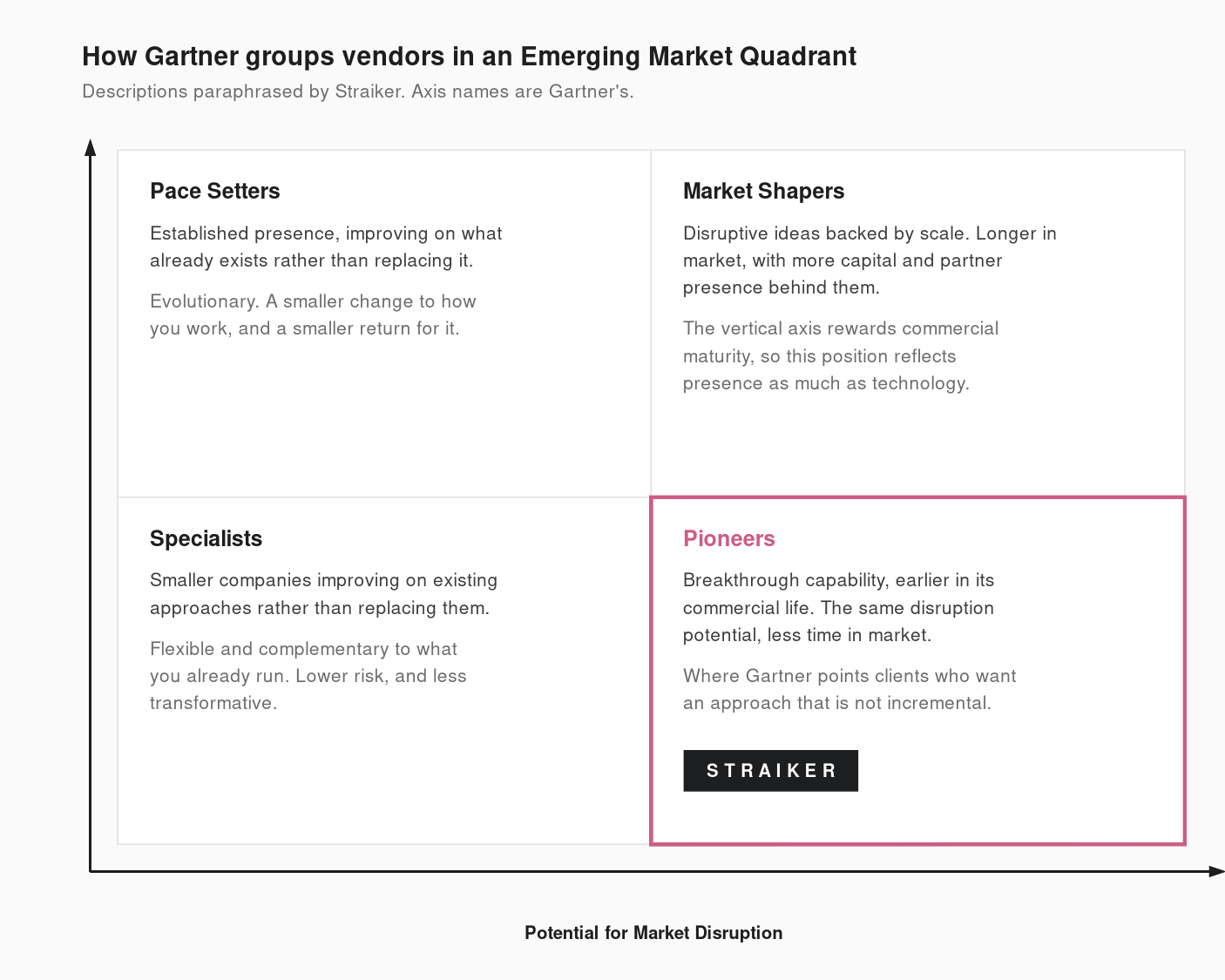
Gartner has placed Straiker in Pioneers, the high-disruption quadrant of its Emerging Market Quadrant for AI Application Security.
Twenty-two vendors were included, out of hundreds competing in this category. Inclusion is not automatic. A vendor has to offer every mandatory capability in Gartner's published market definition, and the analysts have to judge it an innovator worth putting in front of their clients.
How to read Gartner’s Emerging Market Quadrant
If you are evaluating this category, it helps to know what this instrument is built to do, because it is not the Magic Quadrant and it answers a different question.
Gartner publishes an Emerging Market Quadrant for markets that are new and moving too quickly for a Magic Quadrant to keep up with. Its job is to help buyers get their bearings in a fast-moving market and build a shortlist worth exploring. Gartner expects markets covered this way to mature into Magic Quadrant coverage later.
Three things are useful to know when you pick it up.
- There is no numbered order. Placement is relative to the vendors included rather than scored against an absolute scale.
- Use it to build a shortlist. Gartner is explicit that no reader should make a purchasing decision, or enter a significant relationship, based on this research alone. That holds for every vendor on the chart. What a product claims and what it actually delivers in your environment is the thing worth testing.
- Expect the EMQ to change and move. Gartner reviews these at minimum quarterly and updates them when something material shifts. Each carries an "as of" date, and events after that date are not reflected.
What Does Gartner’s Emerging Market Quadrant Measure?
Gartner publishes the criteria behind both axes, which makes this easy to be precise about.
Potential for Market Disruption is assessed on Value Maturity, Breadth of Market Impact, Depth of Market Impact and Competitive Advantage. This is the axis about the idea and its effect on the market.
Potential to Execute is assessed on Human Resources, Financial Resources, Key Partnerships and Ecosystem Affinity. This is the axis about the machine around the idea: how many people, how much capital, how broad a partner footprint, how well positioned in the wider ecosystem.
Where Gartner Has Recognized Straiker Across AI Security
Gartner writes about Straiker in several places. We are a Representative Vendor in the Market Guide for Guardian Agents and a Sample Vendor in three Hype Cycles: Cybersecurity Leadership, Agentic AI, and Workspace Security. Gartner has also recognized our offensive AI security testing for AI agents as distinct.
How Customers Are Using Straiker for AI Agent Security–Why Customers Need Straiker
This is where the argument actually gets settled.
A global retailer in Asia runs twenty agents in production with us, including a consumer-facing application handling millions of queries a day, with runtime guardrails configured for local privacy requirements. They displaced an incumbent vendor to do it and were live within a month of finishing the evaluation. Five months later they expanded.
A regulated fintech runs our runtime enforcement across ten million agentic requests a day. When people ask whether this holds up at scale, that is the number I give them.
A consumer products company ran our offensive testing against their customer service agent, did not like what came back, and rebuilt the agent around the findings. They then expanded from one product to all three. That sequence is the one I find most telling, because it means the findings were specific enough to act on.
We are confident in what we are delivering for our customers, and our renewals and expansions speak for themselves. Teams come to us after putting agents into production and finding their existing tooling cannot see what those agents are doing. Once we show them, they widen the scope.
Our partners, including national resellers, regional VARs and global systems integrators, trust us and continuously put us in front of their customers with AI security needs.
Two numbers matter most when agents are moving this fast: 127 millisecond detection at p50, and a false positive rate six to twenty one times lower than a frontier model prompted to do the same job. A tool that is accurate but slow will get bypassed, and a tool that is fast but noisy will get switched off, so we built for both.
You do not have to take any of this from me. Straiker is rated 4.7 on Gartner Peer Insights, where verified users write about the deployments they run.
Why Straiker Takes an Agent-Centric Approach to AI Security
Most of this market bet on securing the model. We bet the model is the least interesting part of the attack surface, because an agent is dangerous through everything it touches: the data it reads, the tools it calls, the reasoning it performs, and the application logic around it.
Static rules cannot secure a surface that is generated at runtime. So we secure AI with AI, using purpose-built models. We secure what agents do at runtime, and we prove it by attacking them first. A year of continuous pre-release adversarial testing for frontier lab agents gave us a dataset of agentic failure modes that cannot be bought or scraped.
Three things we think happen next, and they are why we are comfortable being early here.
Agents are going to be everywhere. The agents an enterprise builds are the ones with the deepest access to its data and systems, and securing those is the hardest and most valuable version of this problem. That work does not shrink. What gets added on top is everything else: agents inside purchased software, assistants employees turn on, agents reaching in from partners. Security has to cover the whole estate, and the teams who solved it properly for what they built are the ones ready for the rest.
Attack and defend become one closed loop. Finding an exploitable path only matters if it changes what gets blocked tomorrow. Testing that does not feed enforcement is a report, and enforcement that is not informed by real attacks is guesswork. The two belong in the same system.
Control moves to the customer. When an agent starts doing something it should not, most enterprises today depend on whatever controls the model provider chose to expose, on the provider's timeline. That is not a tenable place for a CISO to sit. The ability to stop an agent, an agentic kill switch, belongs in the hands of the company running it rather than the company that built the model.
Every quarter that agents get more capable and more connected, that bet pays off more.
How the AI Application Security Market Is Evolving
Nobody has settled what this market is called. Gartner assesses it as AI application security and separately covers adjacent ground under AI TRiSM and guardian agents. KuppingerCole called their version GenAI Defense last year and has since retired that name in favor of six distinct categories. Aragon Research defined a new category entirely a few months ago, agentic identity and security platforms, and named Straiker in it.
Three analyst firms, each with its own nuanced take and its own framework, all within about twelve months. That is what a market looks like while it is forming, and it is why we would rather be judged on what our product does in your environment than on which box it lands in this quarter.
Additional Industry Recognition for Straiker
Straiker won the 2026 Intellyx Digital Innovator Award, which Intellyx awards on the strength of the briefing itself and never for being a client. We were named a SINET 16 Honoree, a Top InfoSec Innovator Finalist, and selected to the 2026 CB Insights AI 100 as well as Fortune's Cyber 60 for the second consecutive year. Additionally, Straiker won two awards at The Hacker News Cybersecurity Stars Awards 2026 for Best Cybersecurity Startup and Best AI Security Testing Platform.
Investors backed the thesis again this year. A $64 million Series A brought total funding past $85 million, with both seed co-leads, Bain Capital Ventures and Lightspeed Venture Partners, participating a second time.
How to Evaluate AI Application Security Vendors
If you are evaluating this category, a chart will not tell you what you need to know, and Gartner says as much themselves.
Run the vendors you are considering against your own agents. Give everyone the same environment and the same window. Look at what each one actually finds, what it blocks, how fast, and how often it gets in your users' way. Then ask each vendor what is contractual and what is marketing.
That is the format where the differences show, and it is the one we would choose.
Are you ready to start securing your own agents? Talk to us about running an assessment on your own agents →
Gartner, Emerging Market Quadrant for AI Application Security, 2026. GARTNER is a registered trademark and service mark of Gartner, Inc. and/or its affiliates in the U.S. and internationally and is used herein with permission. All rights reserved. Gartner does not endorse any vendor, product or service depicted in its research publications and does not advise technology users to select only those vendors with the highest ratings or other designation. Gartner research publications consist of the opinions of Gartner's research organization and should not be construed as statements of fact. Gartner disclaims all warranties, expressed or implied, with respect to this research, including any warranties of merchantability or fitness for a particular purpose.
Gartner has placed Straiker in Pioneers, the high-disruption quadrant of its Emerging Market Quadrant for AI Application Security.
Twenty-two vendors were included, out of hundreds competing in this category. Inclusion is not automatic. A vendor has to offer every mandatory capability in Gartner's published market definition, and the analysts have to judge it an innovator worth putting in front of their clients.
How to read Gartner’s Emerging Market Quadrant
If you are evaluating this category, it helps to know what this instrument is built to do, because it is not the Magic Quadrant and it answers a different question.
Gartner publishes an Emerging Market Quadrant for markets that are new and moving too quickly for a Magic Quadrant to keep up with. Its job is to help buyers get their bearings in a fast-moving market and build a shortlist worth exploring. Gartner expects markets covered this way to mature into Magic Quadrant coverage later.
Three things are useful to know when you pick it up.
- There is no numbered order. Placement is relative to the vendors included rather than scored against an absolute scale.
- Use it to build a shortlist. Gartner is explicit that no reader should make a purchasing decision, or enter a significant relationship, based on this research alone. That holds for every vendor on the chart. What a product claims and what it actually delivers in your environment is the thing worth testing.
- Expect the EMQ to change and move. Gartner reviews these at minimum quarterly and updates them when something material shifts. Each carries an "as of" date, and events after that date are not reflected.
What Does Gartner’s Emerging Market Quadrant Measure?
Gartner publishes the criteria behind both axes, which makes this easy to be precise about.
Potential for Market Disruption is assessed on Value Maturity, Breadth of Market Impact, Depth of Market Impact and Competitive Advantage. This is the axis about the idea and its effect on the market.
Potential to Execute is assessed on Human Resources, Financial Resources, Key Partnerships and Ecosystem Affinity. This is the axis about the machine around the idea: how many people, how much capital, how broad a partner footprint, how well positioned in the wider ecosystem.
Where Gartner Has Recognized Straiker Across AI Security
Gartner writes about Straiker in several places. We are a Representative Vendor in the Market Guide for Guardian Agents and a Sample Vendor in three Hype Cycles: Cybersecurity Leadership, Agentic AI, and Workspace Security. Gartner has also recognized our offensive AI security testing for AI agents as distinct.
How Customers Are Using Straiker for AI Agent Security–Why Customers Need Straiker
This is where the argument actually gets settled.
A global retailer in Asia runs twenty agents in production with us, including a consumer-facing application handling millions of queries a day, with runtime guardrails configured for local privacy requirements. They displaced an incumbent vendor to do it and were live within a month of finishing the evaluation. Five months later they expanded.
A regulated fintech runs our runtime enforcement across ten million agentic requests a day. When people ask whether this holds up at scale, that is the number I give them.
A consumer products company ran our offensive testing against their customer service agent, did not like what came back, and rebuilt the agent around the findings. They then expanded from one product to all three. That sequence is the one I find most telling, because it means the findings were specific enough to act on.
We are confident in what we are delivering for our customers, and our renewals and expansions speak for themselves. Teams come to us after putting agents into production and finding their existing tooling cannot see what those agents are doing. Once we show them, they widen the scope.
Our partners, including national resellers, regional VARs and global systems integrators, trust us and continuously put us in front of their customers with AI security needs.
Two numbers matter most when agents are moving this fast: 127 millisecond detection at p50, and a false positive rate six to twenty one times lower than a frontier model prompted to do the same job. A tool that is accurate but slow will get bypassed, and a tool that is fast but noisy will get switched off, so we built for both.
You do not have to take any of this from me. Straiker is rated 4.7 on Gartner Peer Insights, where verified users write about the deployments they run.
Why Straiker Takes an Agent-Centric Approach to AI Security
Most of this market bet on securing the model. We bet the model is the least interesting part of the attack surface, because an agent is dangerous through everything it touches: the data it reads, the tools it calls, the reasoning it performs, and the application logic around it.
Static rules cannot secure a surface that is generated at runtime. So we secure AI with AI, using purpose-built models. We secure what agents do at runtime, and we prove it by attacking them first. A year of continuous pre-release adversarial testing for frontier lab agents gave us a dataset of agentic failure modes that cannot be bought or scraped.
Three things we think happen next, and they are why we are comfortable being early here.
Agents are going to be everywhere. The agents an enterprise builds are the ones with the deepest access to its data and systems, and securing those is the hardest and most valuable version of this problem. That work does not shrink. What gets added on top is everything else: agents inside purchased software, assistants employees turn on, agents reaching in from partners. Security has to cover the whole estate, and the teams who solved it properly for what they built are the ones ready for the rest.
Attack and defend become one closed loop. Finding an exploitable path only matters if it changes what gets blocked tomorrow. Testing that does not feed enforcement is a report, and enforcement that is not informed by real attacks is guesswork. The two belong in the same system.
Control moves to the customer. When an agent starts doing something it should not, most enterprises today depend on whatever controls the model provider chose to expose, on the provider's timeline. That is not a tenable place for a CISO to sit. The ability to stop an agent, an agentic kill switch, belongs in the hands of the company running it rather than the company that built the model.
Every quarter that agents get more capable and more connected, that bet pays off more.
How the AI Application Security Market Is Evolving
Nobody has settled what this market is called. Gartner assesses it as AI application security and separately covers adjacent ground under AI TRiSM and guardian agents. KuppingerCole called their version GenAI Defense last year and has since retired that name in favor of six distinct categories. Aragon Research defined a new category entirely a few months ago, agentic identity and security platforms, and named Straiker in it.
Three analyst firms, each with its own nuanced take and its own framework, all within about twelve months. That is what a market looks like while it is forming, and it is why we would rather be judged on what our product does in your environment than on which box it lands in this quarter.
Additional Industry Recognition for Straiker
Straiker won the 2026 Intellyx Digital Innovator Award, which Intellyx awards on the strength of the briefing itself and never for being a client. We were named a SINET 16 Honoree, a Top InfoSec Innovator Finalist, and selected to the 2026 CB Insights AI 100 as well as Fortune's Cyber 60 for the second consecutive year. Additionally, Straiker won two awards at The Hacker News Cybersecurity Stars Awards 2026 for Best Cybersecurity Startup and Best AI Security Testing Platform.
Investors backed the thesis again this year. A $64 million Series A brought total funding past $85 million, with both seed co-leads, Bain Capital Ventures and Lightspeed Venture Partners, participating a second time.
How to Evaluate AI Application Security Vendors
If you are evaluating this category, a chart will not tell you what you need to know, and Gartner says as much themselves.
Run the vendors you are considering against your own agents. Give everyone the same environment and the same window. Look at what each one actually finds, what it blocks, how fast, and how often it gets in your users' way. Then ask each vendor what is contractual and what is marketing.
That is the format where the differences show, and it is the one we would choose.
Are you ready to start securing your own agents? Talk to us about running an assessment on your own agents →
Gartner, Emerging Market Quadrant for AI Application Security, 2026. GARTNER is a registered trademark and service mark of Gartner, Inc. and/or its affiliates in the U.S. and internationally and is used herein with permission. All rights reserved. Gartner does not endorse any vendor, product or service depicted in its research publications and does not advise technology users to select only those vendors with the highest ratings or other designation. Gartner research publications consist of the opinions of Gartner's research organization and should not be construed as statements of fact. Gartner disclaims all warranties, expressed or implied, with respect to this research, including any warranties of merchantability or fitness for a particular purpose.

Secure your agentic AI and AI-native application journey with Straiker
.avif)